
Stocks, Bonds, and Funds: A Plain-Language Map of the Investment Landscape
Confused by stocks, bonds, and mutual funds? This guide breaks down each asset class in clear, jargon-free terms for first-time investors.
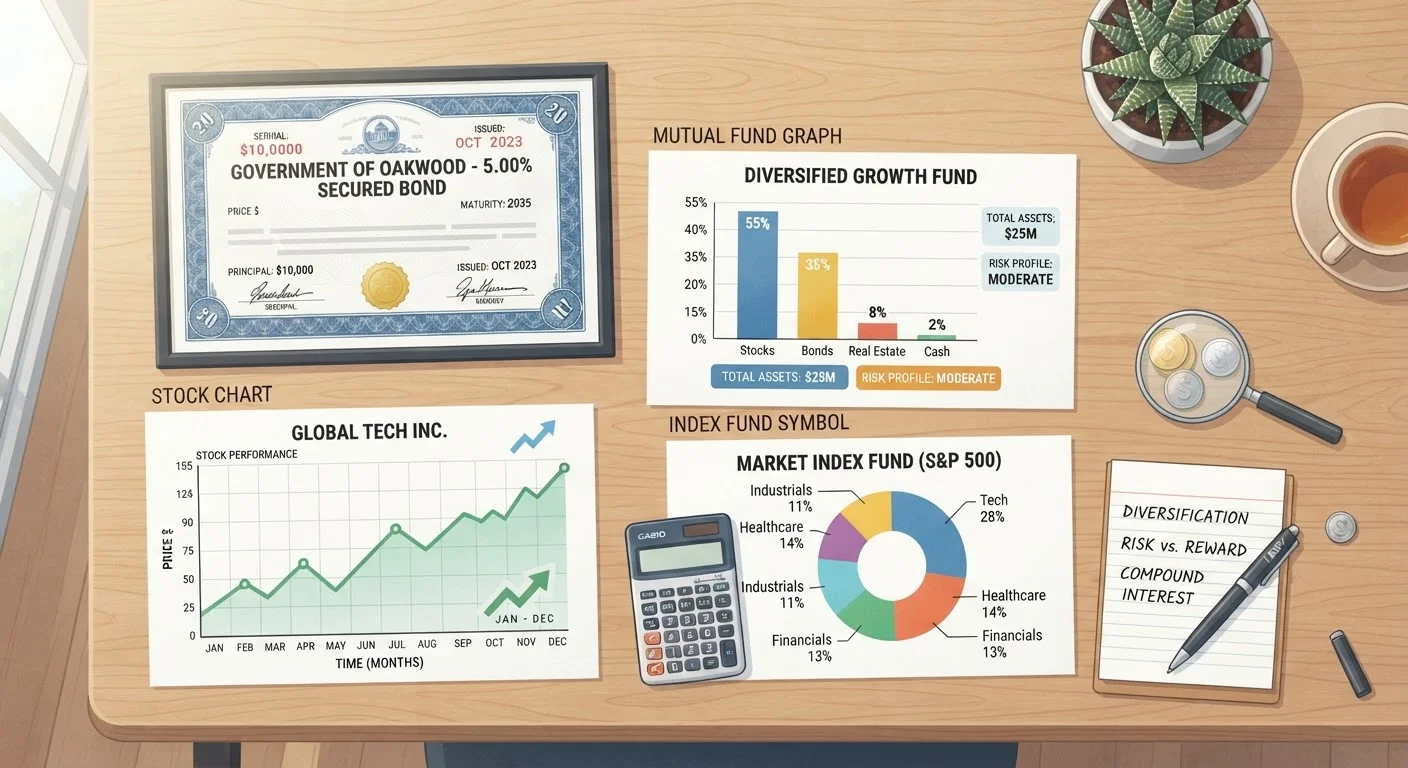
Photo: HorizonMetric.com | One Destination For Everyday Insights editorial
—— In This Article
The Three Building Blocks of Investing
Most investment portfolios are built from three core asset classes: stocks, bonds, and funds. Each works differently, carries different levels of risk, and plays a different role in a long-term financial plan. If you're just getting started, see our beginner's introduction to investing for the foundational context before diving into individual asset types.
| What stocks represent | Partial ownership (equity) in a company |
| What bonds represent | A loan to a government or corporation in exchange for interest |
| What funds provide | Instant diversification across many assets in one purchase |
| Typical stock risk level | Higher volatility; higher long-term growth potential |
| Typical bond risk level | Lower volatility; more predictable income, lower growth potential |
| Key fund cost to watch | Expense ratio (annual fee as % of investment) |
Understanding what each asset class is — before worrying about which to choose — is the most important first step. This article is general financial education, not personalized investment advice. Consult a licensed financial adviser for guidance specific to your situation.
Stocks: Owning a Piece of a Company
When you buy a stock (also called a share or equity), you become a part-owner of the company that issued it. If the company grows and earns more profit, the value of your shares may rise. If the company struggles, the share price can fall — sometimes sharply.
Stockholders can earn money in two ways:
- Price appreciation: selling shares for more than you paid
- Dividends: periodic cash payments some companies distribute from their profits
Stocks historically have offered higher long-term growth potential than bonds, but that potential comes with greater short-term volatility. A stock's value can swing dramatically based on company performance, industry trends, or broader economic conditions. Past performance does not guarantee future results.
Stock (Equity)
A share of ownership in a company. Stockholders may benefit from price increases and dividends, but also bear the risk of losses if the company's value declines.
Bond
A debt instrument where an investor lends money to an issuer (government or corporation) in exchange for regular interest payments and return of principal at maturity.
Mutual Fund
A pooled investment vehicle managed by a professional that collects money from many investors and buys a diversified mix of stocks, bonds, or other assets.
Index Fund
A type of fund designed to replicate the performance of a specific market index, such as the S&P 500, usually with lower fees than actively managed funds.
ETF (Exchange-Traded Fund)
Similar to an index fund but traded on a stock exchange throughout the day like an individual stock. ETFs typically have low expense ratios.
Diversification
The strategy of spreading investments across multiple assets or asset classes to reduce the impact of any single poor-performing investment on the overall portfolio.
Expense Ratio
An annual fee charged by a fund, expressed as a percentage of your investment. A 0.10% expense ratio means you pay $1 per year for every $1,000 invested.
Dividend
A portion of a company's profits paid out to shareholders, usually on a quarterly basis. Not all stocks pay dividends.
Bonds: Lending Money for a Fixed Return
A bond is essentially a loan you make to a government or corporation. The borrower agrees to pay you back the original amount (called the principal) by a set date, plus regular interest payments along the way.
Bonds are generally considered lower-risk than stocks because the income stream is more predictable. However, they are not risk-free:
- Credit risk: the issuer could default and fail to repay
- Interest rate risk: when interest rates rise, existing bond prices typically fall
U.S. Treasury bonds are backed by the federal government and are widely regarded as among the lower-risk bond options, while corporate bonds vary in risk depending on the financial health of the issuing company. Before assuming any bond is "safe," it helps to review key financial terms like yield and credit rating.
Funds: Built-In Diversification
Rather than buying individual stocks or bonds, many investors use funds — pooled investment vehicles that hold a collection of assets. Two common types are:
- Mutual funds: pooled money managed by a professional who selects investments according to the fund's stated strategy
- Index funds / ETFs (Exchange-Traded Funds): designed to track a market index (like the S&P 500) rather than relying on active management, typically with lower fees
The main advantage of funds is diversification — spreading your money across many holdings so that one poor performer has less impact on your overall portfolio. Funds charge an expense ratio, an annual fee expressed as a percentage of your investment. Even small differences in fees can compound significantly over time, so it's worth understanding this cost.
~$0
Minimum to start with many index funds today
Several major fund providers have eliminated investment minimums for certain index funds, though terms vary by provider and account type.
0.03%–1%+
Typical expense ratio range across fund types
Passively managed index funds often carry expense ratios well below 0.10%, while actively managed funds can exceed 1% annually, per Morningstar data.
500+
Companies held in a single S&P 500 index fund
An S&P 500 index fund tracks roughly 500 large U.S. companies, providing broad market exposure through a single fund.
New investors often encounter common myths about funds and market timing that lead to avoidable mistakes. Once you understand the basics, also be aware of the portfolio decisions that commonly backfire for beginners.
This article is for general informational and educational purposes only and does not constitute personalized financial, investment, tax, or legal advice. Consult a qualified financial professional before making investment decisions.

Finance Editorial Team
Finance Editorial Team is the collective byline for our editorial team and contributor network. Articles published under this byline or an editorial pen name are researched, written, and reviewed according to our editorial standards for clarity, consistency, and independence before publication.
View author profile