
Dollar-Cost Averaging vs. Lump-Sum Investing: What the Evidence Says
Should you invest all at once or spread it over time? Compare both strategies, their trade-offs, and when each approach tends to make more sense.
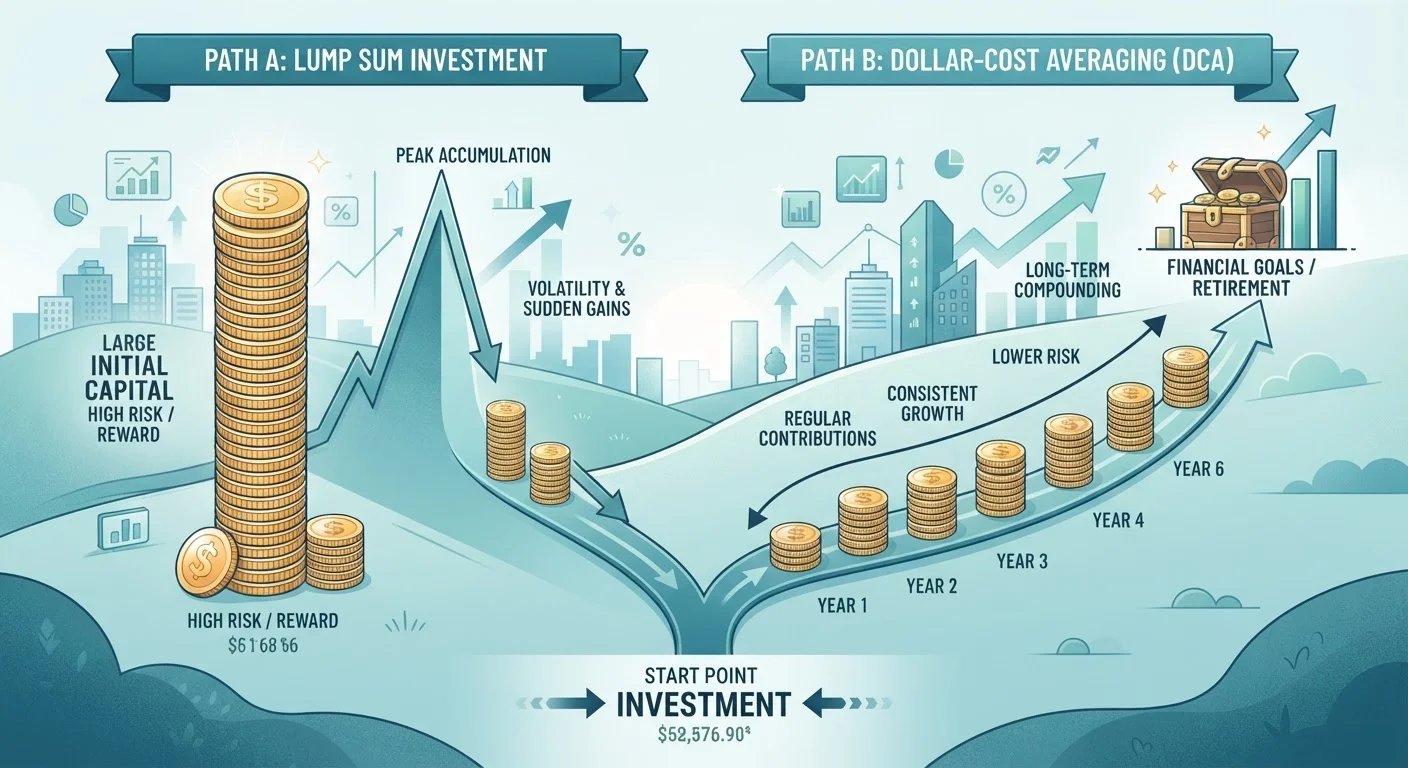
Photo: HorizonMetric.com | One Destination For Everyday Insights editorial
—— In This Article
Key Takeaways
- Lump-sum investing tends to outperform dollar-cost averaging in rising markets, according to historical research.
- Dollar-cost averaging reduces the emotional stress of investing a large sum all at once.
- Neither strategy eliminates investment risk — all investing involves the potential for loss.
- Your choice may depend more on your available capital and risk tolerance than on math alone.
- Consulting a licensed financial adviser can help match a strategy to your specific situation.
The Core Question: All at Once or Over Time?
When you have money ready to invest — whether from savings, an inheritance, or a bonus — one of the first decisions you face is when to put it to work. Two dominant approaches frame this choice:
- Lump-sum investing: deploying your entire available capital into the market in a single transaction.
- Dollar-cost averaging (DCA): spreading your investment across equal installments over a set period — for example, investing $500 per month for 12 months instead of $6,000 upfront.
Both strategies are legitimate. Understanding how they differ — and what the evidence shows — can help you make a more confident decision. This article is general financial education, not personalized investment advice. For guidance tailored to your circumstances, consult a licensed financial adviser.
If you're still building the habits and knowledge that support good investing decisions, see our overview of common investing myths that tend to keep beginners on the sidelines.
What the Research Generally Shows
Studies examining long historical market data — including widely cited research by Vanguard — have consistently found that lump-sum investing outperforms dollar-cost averaging roughly two-thirds of the time across major equity markets. The reasoning is straightforward: markets have historically trended upward over long periods. Every day your money is not fully invested is a day it may miss potential growth.
~68%
Lump sum outperforms DCA historically
Vanguard research analyzing U.S., U.K., and Australian market data found lump-sum investing outperformed 12-month DCA approximately two-thirds of the time.
~2/3
Of time markets trend upward annually
Long-run historical data on major equity markets shows positive annual returns in roughly two out of every three calendar years, which structurally advantages earlier investment.
That said, one-third of the time, markets do decline shortly after a lump-sum entry — and in those windows, DCA limits early exposure. The research doesn't guarantee future results; past market performance is not a predictor of what markets will do next.
Dollar-cost averaging also has a structural advantage for the majority of American workers: most people don't have a large lump sum available. Contributing steadily from each paycheck is, in practice, a form of automatic DCA — and it's a sound wealth-building habit regardless of the debate.
Comparing the Two Approaches
The table below summarizes the key differences across several practical dimensions:
| Dollar-Cost Averaging | Lump-Sum Investing | |
|---|---|---|
| Historical return potential | Slightly lower on average | Higher in ~2/3 of market periods |
| Exposure to early market drops | Reduced — capital enters gradually | Full — all capital invested immediately |
| Behavioral / emotional ease | Easier — steady, automatic schedule | Harder — requires confidence upfront |
| Best suited capital source | Regular paycheck contributions | Windfall, inheritance, or saved lump sum |
| Inflation / idle-cash risk | Higher — cash waits before investing | Lower — capital deployed immediately |
| Market timing dependency | Low — averages entry price over time | Higher — entry point matters more |
One nuance worth noting: if you receive a windfall and deliberately hold cash to spread it over time, you are accepting a real trade-off — the cash sitting idle may lose purchasing power to inflation and misses potential market gains. That's not always the wrong call, but it should be a conscious decision rather than an accidental one.
The Psychology Factor — and Why It Matters
Evidence favoring lump-sum investing assumes rational, disciplined behavior. In practice, investing psychology plays a significant role. Investing a large sum and then watching markets drop sharply can trigger panic selling — which tends to lock in losses and disrupt long-term plans. Research in behavioral finance has consistently found that emotional reactions to short-term market moves are one of the leading causes of underperformance among individual investors.
Automate to Remove Emotion from the Equation
One practical way to implement DCA — or simply build consistent investing habits — is to automate contributions on a fixed schedule, such as the day after each paycheck. Automation reduces the temptation to pause when markets feel uncertain, and it removes decision fatigue from the process. Many employer-sponsored retirement plans, like 401(k)s, do this by default, which is one reason they're such an effective savings tool for working Americans.
Dollar-cost averaging can serve as a behavioral guardrail. By committing to a regular schedule, investors remove the temptation to time the market and build a consistent habit. For investors prone to second-guessing, the psychological value of DCA may outweigh its historical return disadvantage.
For more on how emotional decision-making affects investing outcomes, see our article on common portfolio mistakes new investors make.
How to Decide Which Approach Fits Your Situation
There's no universal right answer. Several factors are worth weighing:
- Capital availability: If you're investing from regular income, DCA is often the natural default. If you have a large sum already accumulated, the lump-sum question becomes more relevant.
- Time horizon: The longer your intended investment period, the more time a lump sum has to recover from early market dips. Shorter horizons reduce that buffer.
- Risk tolerance: How would you react to a 20% portfolio drop in the first month? If honestly you'd sell, a more gradual entry may help you stay the course.
- Tax and account considerations: The mechanics of when and how you invest may interact with contribution limits, tax timing, and account types. A financial professional can help you think through specifics.
Whichever approach you choose, pairing it with sound diversification is important. Our guide to diversification in practice explains how spreading risk across asset types works alongside either strategy.
This article is for general informational and educational purposes only and does not constitute personalized financial, investment, tax, or legal advice. All investing involves risk, including the potential loss of principal. Consult a qualified, licensed financial adviser before making investment decisions based on your individual circumstances.

Finance Editorial Team
Finance Editorial Team is the collective byline for our editorial team and contributor network. Articles published under this byline or an editorial pen name are researched, written, and reviewed according to our editorial standards for clarity, consistency, and independence before publication.
View author profile