
Diversification in Practice: Spreading Risk Without Overcomplicating Your Portfolio
Diversification is more than a buzzword. Learn what it means to spread investment risk, why it matters, and how it works across asset types.
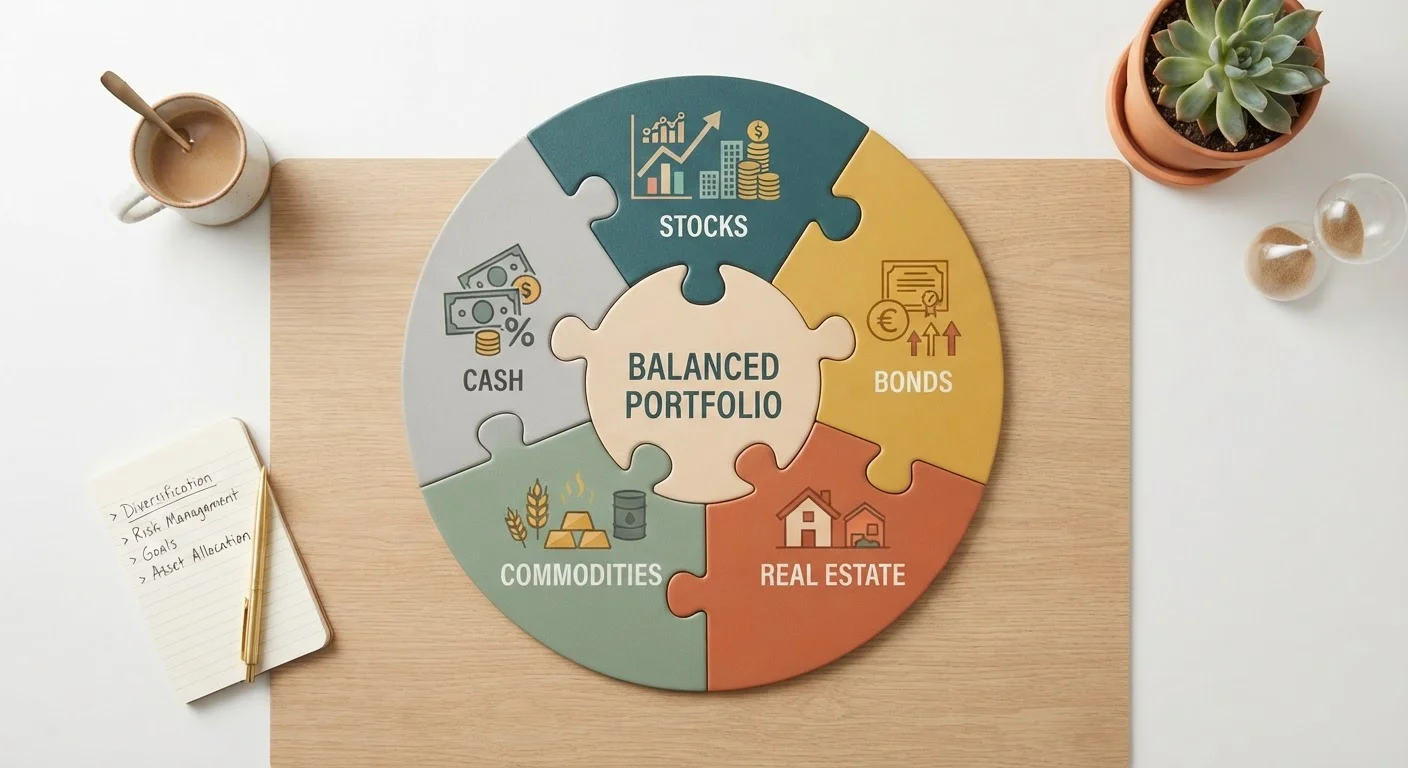
Photo: HorizonMetric.com | One Destination For Everyday Insights editorial
—— In This Article
Key Takeaways
- Diversification spreads risk across different investments so one loss doesn't devastate your portfolio.
- True diversification goes beyond owning many stocks — it includes different asset classes and geographies.
- Over-diversifying can dilute returns and add unnecessary complexity without meaningful added protection.
- Low-cost index funds offer a simple, built-in path to diversification for most beginners.
- Your ideal mix should reflect your time horizon, goals, and personal comfort with risk.
What Diversification Actually Means
Diversification is often summed up as "don't put all your eggs in one basket" — and that captures the idea well. In investing, it means spreading your money across different types of assets so that a sharp decline in one area doesn't wipe out your entire portfolio.
But diversification is more nuanced than simply owning a lot of different things. You could hold 30 technology stocks and still be highly concentrated if they all move in the same direction when markets shift. Real diversification means owning assets that don't all react the same way to the same economic events — what investors call low correlation.
As you explore this concept, it helps to understand that diversification and risk are closely linked. Every investment carries some trade-off between potential gain and potential loss. Our guide to risk and return explains how that relationship works and why it matters when building any investment strategy.
Correlation Is the Key Concept
When two investments are highly correlated, they tend to rise and fall together — so owning both doesn't provide much protection. Look for assets with low or negative correlation to one another. Stocks and high-quality government bonds, for example, have historically moved in opposite directions during many market downturns, which is why combining them can reduce overall volatility.
The Building Blocks: Asset Classes and Why They Matter
A well-diversified portfolio typically draws from several major asset classes — broad categories of investments that behave differently under various market conditions:
- Stocks (equities): Ownership shares in companies. Historically, stocks have offered higher long-term growth but with greater short-term volatility.
- Bonds (fixed income): Loans you make to governments or corporations in exchange for regular interest payments. Generally less volatile than stocks, but with lower growth potential.
- Cash and cash equivalents: Savings accounts, money market funds, and short-term Treasury bills. Safe, liquid, but rarely outpace inflation over time.
- Real assets: Real estate investment trusts (REITs) or commodities like gold, which can behave differently from stocks and bonds.
Within each class, you can diversify further — across industries, company sizes (large-cap vs. small-cap), and geographic regions (U.S. vs. international markets). How you divide your money among these categories is called asset allocation, and it tends to shift as you move through life. The shift in asset allocation across life stages is worth understanding before you finalize any portfolio mix.
Geographic Concentration Is a Hidden Risk
Many U.S. investors unknowingly hold portfolios concentrated almost entirely in American companies. While U.S. markets have performed well historically, no single country's outperformance is guaranteed to continue. Adding international exposure — including developed and emerging markets — can reduce the impact if U.S. growth slows. Past performance does not guarantee future results.
How to Build a Diversified Portfolio Step by Step
Here's a practical process for applying diversification — whether you're starting from scratch or reviewing what you already own.
What you will need
Define your goal and time horizon
Before choosing any investment, clarify what you're investing for — retirement in 30 years, a home purchase in 5 years, or general wealth building. Your time horizon directly influences how much risk is appropriate. Longer horizons generally allow more exposure to volatile assets like stocks, because there's time to recover from downturns.
Choose a target asset allocation
Based on your time horizon and risk tolerance, decide on a rough split between stocks, bonds, and other asset classes. A common starting framework is to hold a higher proportion of stocks when young, gradually shifting toward bonds as you approach your goal. There is no universally correct allocation — it should reflect your specific situation.
Select low-cost, broad index funds
For most beginners, broad index funds — which track large market benchmarks — offer immediate diversification at low cost. A single U.S. total market index fund may hold thousands of stocks across every industry. Adding an international index fund and a bond index fund can cover the core of a diversified portfolio without complexity.
Diversify within each asset class
Don't stop at asset classes. Within your stock allocation, consider spreading across U.S. and international markets, different industries (technology, healthcare, consumer goods), and company sizes. Within bonds, mix short-term and long-term maturities, and consider government alongside corporate bonds.
Rebalance periodically
Over time, some investments will grow faster than others, shifting your portfolio away from your target allocation. Rebalancing means selling a portion of overweight holdings and adding to underweight ones to restore your intended mix. Most investors rebalance once or twice a year, or when any asset class drifts significantly from its target.
Avoid over-diversifying
There's a point at which adding more holdings stops reducing risk meaningfully and just adds cost and confusion. Owning five funds that track nearly identical indexes, or dozens of individual stocks across the same sector, adds little protection. Aim for simplicity: a small number of broadly diversified funds can do most of the heavy lifting.
A common pitfall beginners face is confusing activity with strategy. Buying dozens of individual stocks or chasing trending sectors doesn't equal diversification. See common portfolio mistakes new investors make to understand how well-intentioned decisions can backfire.
This article is for general informational and educational purposes only. It does not constitute personalized investment, financial, or tax advice. Please consult a qualified, licensed financial adviser before making decisions about your own investments.

Finance Editorial Team
Finance Editorial Team is the collective byline for our editorial team and contributor network. Articles published under this byline or an editorial pen name are researched, written, and reviewed according to our editorial standards for clarity, consistency, and independence before publication.
View author profile