
Asset Allocation Across Life Stages: How Investment Mix Typically Shifts Over Time
The right balance of stocks, bonds, and cash often changes as you age. Explore how asset allocation thinking typically evolves from your 20s onward.
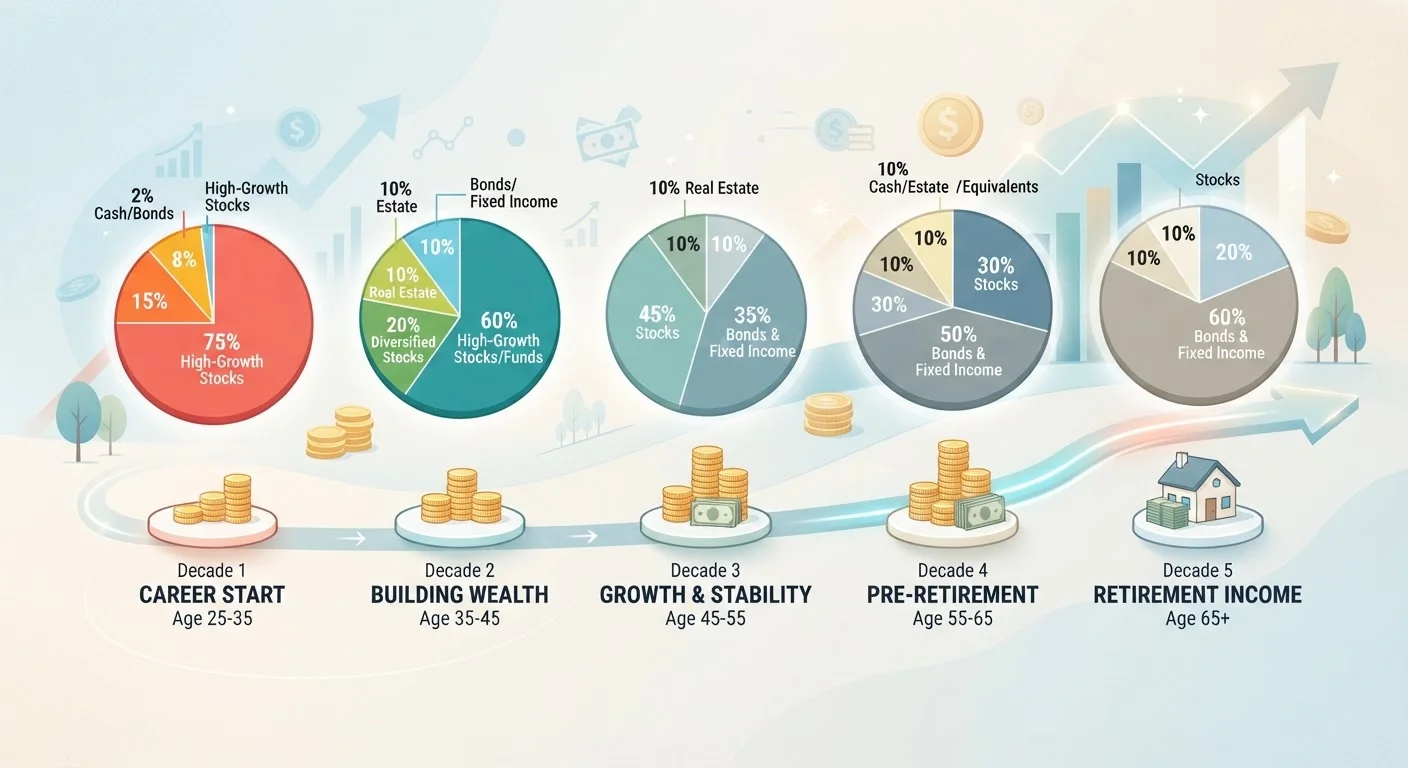
Photo: HorizonMetric.com | One Destination For Everyday Insights editorial
—— In This Article
What Asset Allocation Means and Why It Changes
Asset allocation refers to how your investment portfolio is divided among different asset classes — primarily stocks (equities), bonds (fixed income), and cash or cash equivalents. The mix you choose influences both the potential growth of your investments and the risk you take on.
Asset Allocation
The process of dividing investments among different asset categories such as stocks, bonds, and cash. The mix is designed to balance risk and potential return based on an investor's goals and time horizon.
Equities (Stocks)
Ownership shares in a company. Stocks offer higher growth potential over the long term but tend to be more volatile in the short term compared to bonds or cash.
Fixed Income (Bonds)
Debt instruments issued by governments or corporations that pay regular interest. Bonds are generally less volatile than stocks but typically offer lower long-term growth potential.
Sequence-of-Returns Risk
The danger that the timing of investment losses — particularly early in retirement — can permanently reduce a portfolio's ability to fund withdrawals, even if long-term average returns are acceptable.
Glide Path
The gradual shift in a portfolio's asset allocation over time, typically moving from higher-risk investments toward more conservative ones as a target date (such as retirement) approaches.
Rebalancing
The process of realigning the proportions of assets in a portfolio back to a target allocation, typically by selling assets that have grown beyond their target weight and buying those that have fallen below it.
No single allocation suits every investor at every age. Two core factors drive how the mix typically shifts over time: time horizon (how many years before you need the money) and risk tolerance (how much short-term loss you can absorb without abandoning your plan). As time horizons shorten and responsibilities grow, most investors gradually reduce exposure to volatile assets and increase steadier, more predictable ones.
This is general financial education, not personalized investment advice. A licensed financial adviser can help you evaluate your specific situation.
Asset Allocation by Life Stage: A General Framework
| Typical young investor stock weighting | Higher equity share (often cited around 80–90%) (General industry guidance; varies by individual circumstances) |
| Typical near-retiree stock weighting | Lower equity share (often cited around 40–60%) (General industry guidance; varies by individual circumstances) |
| Average U.S. retirement length | Approximately 18–20+ years (Social Security Administration life expectancy data) |
| Target-date fund glide path | Automatically shifts allocation as target year approaches (Common feature of target-date fund structures) |
| Rebalancing frequency (common practice) | Annually or when allocation drifts significantly (General financial planning guidance) |
Your 20s and early 30s — Growth orientation. With decades until retirement, younger investors typically hold a higher share of stocks. Equities carry more short-term volatility but have historically offered stronger long-term growth potential. A common starting reference is a portfolio weighted more heavily toward stocks, tapering bond and cash exposure. The logic: if markets decline sharply, time allows for recovery. This is also when building an emergency fund and managing debt matter enormously — see balancing retirement saving with other financial goals.
Your 40s — Moderate rebalancing. Career earnings often peak, and financial goals multiply (college savings, mortgage payoff, retirement acceleration). Many investors begin shifting a modest portion from stocks toward bonds, reducing the overall portfolio's sensitivity to market swings while still maintaining meaningful growth exposure.
Your 50s — Gradual de-risking. With retirement potentially 10–15 years away, sequence-of-returns risk becomes a real concern — a major market drop close to retirement can significantly reduce what you can safely withdraw. Investors commonly increase bond allocations and may add more stable, dividend-oriented holdings. Diversification across asset types becomes especially important here.
Your 60s and beyond — Capital preservation with income focus. The portfolio's job shifts from accumulation to distribution. Bonds, cash, and income-generating investments often make up a larger share. However, many retirees still hold some stocks, since retirement can last 20–30 years and some growth is needed to outpace inflation.
Target-Date Funds Automate the Glide Path
Target-date funds adjust their asset allocation automatically over time, becoming more conservative as the stated retirement year approaches. They can be a convenient option for investors who prefer not to manage rebalancing themselves. However, different fund families use different glide paths, so it's worth understanding how a specific fund is structured before investing.
Rules of Thumb, Their Limits, and What Else to Consider
A widely cited guideline suggests subtracting your age from 110 (or 120) to get an approximate stock percentage — so a 40-year-old might aim for roughly 70–80% stocks. Target-date funds automate a similar glide path, gradually shifting allocation as the target retirement year approaches. These can be a useful starting point for investors who prefer a hands-off approach. See how index funds and actively managed funds compare for related context.
20–30 years
Typical retirement duration in the U.S.
According to Social Security Administration data, a 65-year-old today can expect to live well into their 80s on average, underscoring why some growth exposure often continues in retirement.
~110 rule
Common stock-allocation rule of thumb
Subtract your age from 110 to estimate a starting stock percentage; some planners use 120 to reflect longer life expectancies and the need for growth.
Rules of thumb are starting points, not prescriptions. Several factors can justify a different allocation than your age alone implies:
- Pension or Social Security income: Predictable income streams can offset the need for heavy bond exposure in retirement.
- Risk tolerance: Some investors sleep better with fewer stocks even when their time horizon is long.
- Other assets: Real estate or business ownership changes your overall risk picture.
- Contribution rate: Investors who contribute consistently regardless of market conditions — a practice known as dollar-cost averaging — may handle volatility differently than those who invest infrequently.
Regardless of age, maintaining the habits that long-term investors share — staying consistent, rebalancing periodically, and avoiding reactive decisions — tends to matter as much as the allocation itself. Past performance does not guarantee future results, and all investing involves risk, including potential loss of principal. Consult a qualified financial professional before making decisions about your own portfolio.

Finance Editorial Team
Finance Editorial Team is the collective byline for our editorial team and contributor network. Articles published under this byline or an editorial pen name are researched, written, and reviewed according to our editorial standards for clarity, consistency, and independence before publication.
View author profile