
Index Funds vs. Actively Managed Funds: Understanding the Core Difference
Index funds and actively managed funds work very differently. See how each approach compares on cost, risk, and long-term performance history.
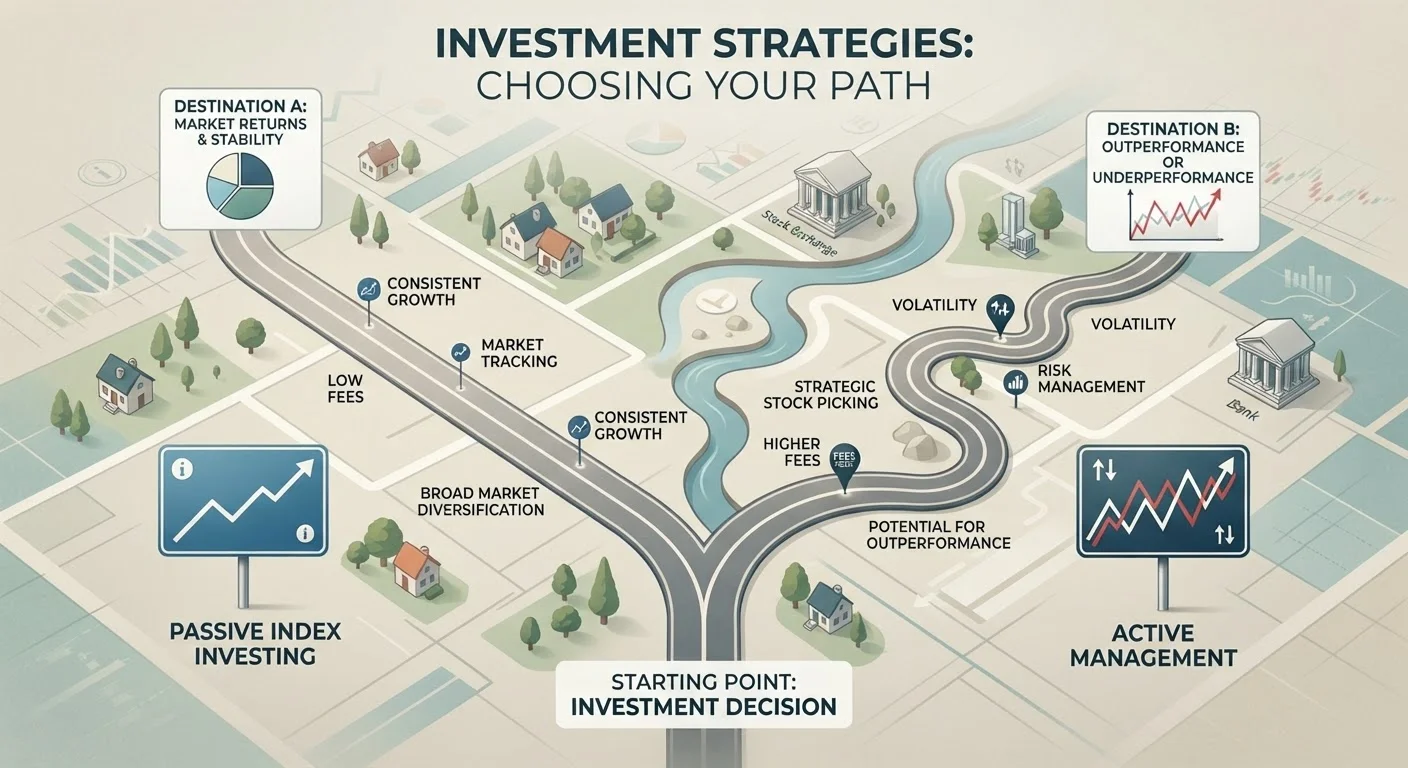
Photo: HorizonMetric.com | One Destination For Everyday Insights editorial
—— In This Article
Key Takeaways
- Index funds track a market benchmark automatically; actively managed funds rely on human stock-picking decisions.
- Index funds typically carry significantly lower expense ratios than actively managed funds.
- Long-term data consistently shows most active funds underperform their benchmark index after fees.
- Neither approach eliminates market risk — both can lose value when markets decline.
- Tax efficiency tends to favor index funds due to lower portfolio turnover.
- Consulting a licensed financial adviser helps match fund type to your personal goals and timeline.
How Each Fund Type Actually Works
Before comparing outcomes, it helps to understand the mechanics. An index fund is designed to replicate the performance of a specific market benchmark — such as the S&P 500 or the total U.S. bond market. The fund buys and holds the same securities as that index, in the same proportions. No manager is deciding which stocks to favor. When the index changes its composition, the fund adjusts accordingly.
An actively managed fund, by contrast, employs a portfolio manager (or a team) who researches securities and makes deliberate buy and sell decisions, aiming to outperform a chosen benchmark. Their choices are driven by analysis, forecasts, and judgment. The fund's success depends heavily on those decisions being correct more often than not — after accounting for costs.
To understand how these fit into the broader investment picture, see our plain-language guide to stocks, bonds, and funds.
| Criterion | Index Funds | Actively Managed Funds |
|---|---|---|
| Management style | Passive — tracks a benchmark | Active — manager makes decisions |
| Typical expense ratio | 0.03%–0.20% | 0.50%–1.25%+ |
| Goal | Match index returns | Beat index returns |
| Portfolio turnover | Low | Often high |
| Tax efficiency | Generally higher | Often lower |
| Long-term benchmark record | Matches benchmark by design | Majority underperform after fees |
| Market risk | Yes — mirrors market | Yes — varies by strategy |
The Fee Gap and Why It Compounds
The most concrete difference between these two fund types is cost. Index funds typically carry expense ratios — the annual fee expressed as a percentage of your investment — well below 0.20%. Many broad-market index funds charge 0.03% to 0.10%. Actively managed funds commonly charge 0.50% to 1.00% or more annually.
That gap may sound small, but it compounds significantly over decades. On a $50,000 portfolio growing at 7% annually, the difference between a 0.05% and a 0.75% expense ratio can translate to tens of thousands of dollars less in the higher-fee account over 30 years. Fees are deducted regardless of fund performance. Learn exactly what expense ratios and commissions cost in real dollar terms to see this math made concrete.
~85%
Active large-cap funds underperforming over 15 years
According to S&P Dow Jones Indices SPIVA U.S. Scorecard data, roughly 85% of actively managed U.S. large-cap funds have underperformed the S&P 500 over 15-year periods.
0.05% vs 0.66%
Average expense ratio: index vs. active funds
Morningstar's annual fund fee study has reported average asset-weighted expense ratios near 0.05% for passive funds and approximately 0.66% for active funds.
$30,000+
Estimated fee drag over 30 years on a $50K portfolio
Illustrative calculation based on a 0.70% annual fee difference compounded over 30 years at a 7% hypothetical annual return — actual results will vary.
What Performance Data Tells Us
The S&P Indices Versus Active (SPIVA) scorecard, published by S&P Dow Jones Indices, tracks how actively managed U.S. equity funds perform against their benchmark indexes over time. Consistently across 10- and 15-year periods, the majority of active funds in most categories have underperformed their relevant index after fees. This pattern holds across U.S. large-cap, mid-cap, and small-cap funds, as well as most international categories.
This does not mean active management never adds value. Some managers do outperform their benchmarks over extended periods. The challenge for investors is identifying those managers in advance — which research suggests is difficult to do reliably. Past outperformance does not guarantee future results.
Active Funds in Less-Efficient Markets
Active management tends to face its steepest challenge in large-cap U.S. stocks, where information is widely available and prices reflect it quickly. In smaller or less-covered markets — certain emerging markets or small-cap segments — some researchers argue active management has a slightly better opportunity to add value. Even so, the fee hurdle remains significant, and outcomes are not guaranteed. Always review a fund's specific strategy and cost structure before drawing conclusions.
Understanding how you invest matters as much as what you invest in. Compare dollar-cost averaging and lump-sum investing to see how contribution strategy interacts with fund choice.
Tax Efficiency and Portfolio Fit
Index funds tend to be more tax-efficient in taxable brokerage accounts. Because they trade infrequently — only when the benchmark itself changes — they generate fewer capital gains distributions that flow through to shareholders. Actively managed funds, with higher portfolio turnover, more regularly trigger taxable events, which can reduce after-tax returns in non-retirement accounts.
Within tax-advantaged accounts like IRAs or 401(k)s, this difference matters less, since gains aren't taxed annually regardless. Still, keeping costs low remains valuable in any account type. Review how Roth and Traditional IRAs compare to understand how account structure affects your overall strategy.
Neither fund type protects you from market-wide losses. Both index and actively managed funds fall when markets decline. The right choice depends on your goals, time horizon, and tolerance for cost and complexity — factors worth reviewing with a licensed financial adviser before committing.
This article is for general informational and educational purposes only and does not constitute personalized financial, investment, tax, or legal advice. Consult a qualified financial professional before making investment decisions.

Finance Editorial Team
Finance Editorial Team is the collective byline for our editorial team and contributor network. Articles published under this byline or an editorial pen name are researched, written, and reviewed according to our editorial standards for clarity, consistency, and independence before publication.
View author profile