
Dietary Fat Has a Complicated Reputation — Here's the Reality
Saturated, unsaturated, trans — sorting out which nutrition claims about fat hold up to scrutiny and which are outdated.
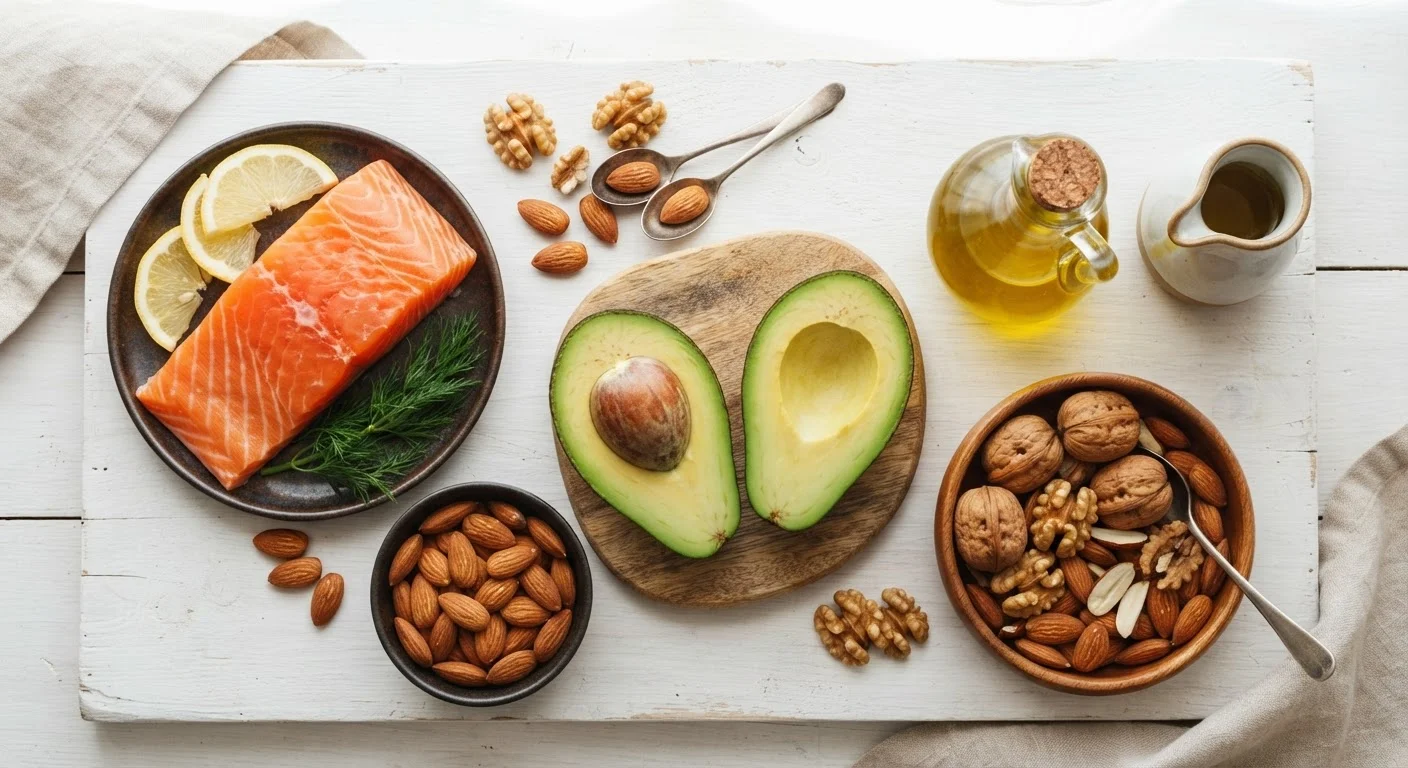
Photo: HorizonMetric.com | One Destination For Everyday Insights editorial
—— In This Article
Key Takeaways
- Dietary fat is essential for brain function, hormone production, and absorbing fat-soluble vitamins.
- Unsaturated fats — found in fish, nuts, and olive oil — are broadly associated with better heart health.
- Industrially produced trans fats are genuinely harmful and largely banned from the U.S. food supply.
- The low-fat diet era led many Americans to replace fat with refined carbohydrates, which did not improve health outcomes.
- Saturated fat's relationship with heart disease is more nuanced than once believed, though most guidelines still advise limiting it.
Why Fat Got Such a Bad Name
For decades, dietary fat was treated as a near-universal villain. Government guidelines, food marketing, and popular health culture converged on a simple message: eat less fat, live longer. Supermarket shelves filled with fat-free cookies, low-fat salad dressings, and reduced-fat snack foods — products that often swapped fat for added sugar and refined starch.
The original concern was cardiovascular disease. Landmark mid-20th-century research linked saturated fat intake to elevated LDL cholesterol, and LDL to heart disease risk. The logic seemed tight, and public health policy followed. What the early research couldn't fully account for was what people ate instead of fat — and whether all fat types behaved the same way in the body.
Nutrition science has since grown considerably more sophisticated. Today, researchers distinguish carefully between fat types, dietary patterns, and individual metabolic differences. The blanket "fat is bad" message has given way to a more textured understanding — one that's worth unpacking clearly.
For a broader look at how nutrition guidance has evolved, see how long-held diet ideas have been revised by later evidence.
Myths vs. Facts: What the Evidence Actually Shows
Several specific beliefs about dietary fat have proven either overstated or outright incorrect. Working through each one helps build a clearer picture of what you can reasonably act on.
Myth
All dietary fat is bad for your heart and should be minimized as much as possible.
Fact
Fat type matters far more than total fat intake. Unsaturated fats — particularly monounsaturated and polyunsaturated varieties — are associated with reduced cardiovascular risk in consistent research.
Monounsaturated fats (found in olive oil, avocados, and most nuts) and polyunsaturated fats (found in fatty fish, walnuts, and flaxseed) have repeatedly shown favorable associations with heart health markers in large observational studies and clinical trials. Omega-3 fatty acids, a subtype of polyunsaturated fat, are particularly well-studied for their anti-inflammatory properties. Lumping these in with harmful fats misrepresents what the evidence shows.
Myth
Eating fat makes you gain body fat directly.
Fact
Body fat accumulation is driven by overall caloric balance and metabolic factors, not by dietary fat consumption in isolation.
All three macronutrients — carbohydrates, protein, and fat — contribute calories, and excess calories from any source can contribute to weight gain. Fat is calorie-dense at 9 calories per gram compared to 4 calories per gram for carbohydrates and protein, so portion context matters. But research does not support the idea that dietary fat is uniquely fattening independent of total energy intake. Low-fat diets have not consistently outperformed other dietary patterns for long-term weight management in clinical trials.
Myth
Saturated fat is definitively proven to cause heart disease.
Fact
The relationship between saturated fat and cardiovascular disease is real but more complicated than early research suggested — the replacement nutrient matters significantly.
Saturated fat does raise LDL cholesterol, which is a risk factor for heart disease. However, more recent meta-analyses have found that when saturated fat is replaced with refined carbohydrates, cardiovascular outcomes do not improve. When replaced with unsaturated fats, outcomes do tend to improve. This suggests the comparison matters as much as the fat itself. Most major health organizations still recommend moderating saturated fat intake, but the simple "saturated fat causes heart attacks" framing overstates what the data shows.
Myth
Trans fats found naturally in some animal foods are just as harmful as industrially produced trans fats.
Fact
Naturally occurring trans fats in dairy and meat — such as conjugated linoleic acid (CLA) — appear to behave differently in the body than artificial trans fats created through industrial hydrogenation.
Artificial trans fats, produced by partially hydrogenating vegetable oils, raise LDL cholesterol and lower HDL cholesterol simultaneously — a particularly unfavorable combination. The U.S. Food and Drug Administration effectively removed them from the food supply by ruling they were no longer GRAS in 2018. Naturally occurring trans fats found in small amounts in ruminant animal products have not shown the same harmful profile in research and may carry neutral or modest beneficial associations. Treating them identically is not supported by current evidence.
Myth
A fat-free diet is the healthiest approach to eating.
Fact
Dietary fat is essential for survival. Fat-soluble vitamins A, D, E, and K require fat for absorption, and fat plays critical roles in hormone production and brain health.
Fat is not optional — it is a required macronutrient. The brain is roughly 60% fat by dry weight, and many hormones, including estrogen and testosterone, are synthesized from fat. Eliminating fat severely restricts absorption of vitamins A, D, E, and K, which depend on fat for uptake in the gut. The fat-free diet era is also associated with increased consumption of highly processed carbohydrate-heavy foods, which research has not found to be a healthier substitution for most people.
Understanding where these myths came from — and why they persisted — also matters. Many originated from real but incomplete data, amplified by decades of food industry marketing and simplified public health messaging. The nutrition myths still circulating on social media often trace back to this same era of oversimplification.
Putting It Into Practice
~20%
Increase in processed snack food consumption during the low-fat diet era
Public health researchers have documented that the 1980s–90s low-fat movement coincided with a significant rise in consumption of low-fat but high-sugar processed foods, complicating intended health outcomes.
9 kcal/g
Calories per gram of dietary fat
Fat is the most calorie-dense macronutrient — more than twice the density of carbohydrates or protein — making portion awareness relevant even with health-promoting fat sources.
~60%
Proportion of the brain composed of fat (dry weight)
According to neurological research, fat — including omega-3 fatty acids like DHA — is a critical structural component of brain tissue, underscoring why eliminating dietary fat entirely is not advisable.
Translating the science into daily habits doesn't require a dramatic overhaul. The core shift is moving away from thinking about fat as a quantity to minimize and toward thinking about fat quality. Replacing butter with olive oil, choosing fatty fish like salmon or sardines a couple of times per week, and reaching for a handful of nuts rather than a processed snack are changes that align with consistent research findings.
Highly processed foods that are also high in saturated fat — fast food, packaged pastries, processed meats — are worth limiting, not because of fat alone but because of the overall nutritional package they deliver. Whole-food sources of saturated fat, like dairy or unprocessed meat, exist in a different context and continue to be studied.
Don't Replace Fat With Ultra-Processed Foods
One of the clearest lessons from the low-fat movement is that removing fat from your diet doesn't automatically improve health — it depends heavily on what replaces it. Foods marketed as "low-fat" or "fat-free" often contain added sugars, refined starches, and sodium to compensate for lost flavor and texture. Read nutrition labels carefully and prioritize whole-food sources of all macronutrients.
Fat is also one of three macronutrients your body depends on. If you're newer to thinking about nutrition in structured terms, a plain-language overview of macronutrients can ground the bigger picture. And if you're evaluating major dietary changes — especially with an existing health condition — a registered dietitian or your primary care provider is the right resource.
This article is for general informational and educational purposes only and is not a substitute for personalized medical or nutritional advice. Consult a qualified healthcare professional before making significant changes to your diet.

Health Editorial Team
Health Editorial Team is the collective byline for our editorial team and contributor network. Articles published under this byline or an editorial pen name are researched, written, and reviewed according to our editorial standards for clarity, consistency, and independence before publication.
View author profile