
What "5G" Actually Means — and What It Doesn't
5G is widely misunderstood. This plain-language explainer separates the genuine improvements from the marketing hype.
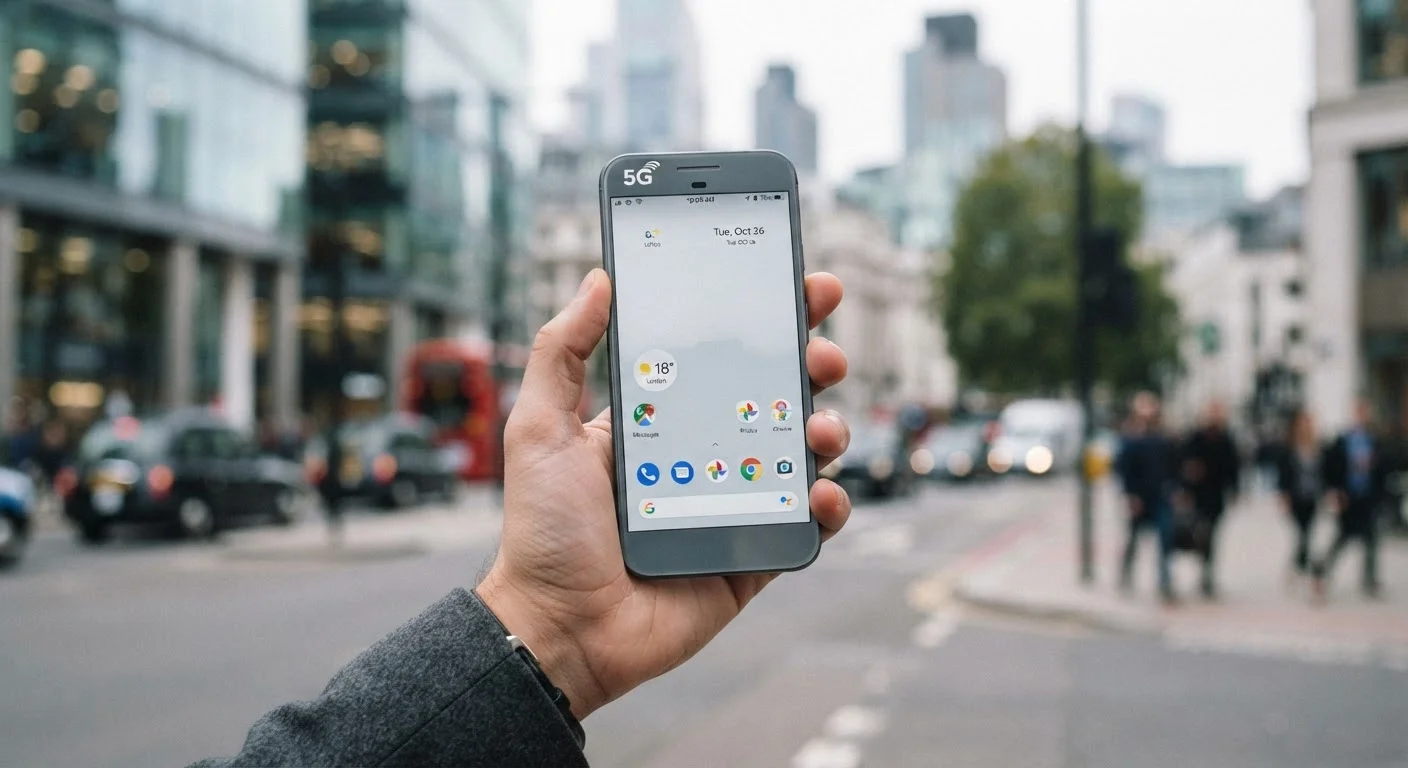
Photo: HorizonMetric.com | One Destination For Everyday Insights editorial
—— In This Article
Key Takeaways
- 5G is faster than 4G in ideal conditions, but most users won't notice dramatic everyday differences.
- The type of 5G your carrier uses matters — not all 5G delivers the same speeds or coverage.
- 5G does not cause health problems; scientific and regulatory consensus supports its safety.
- Having a 5G phone doesn't guarantee 5G service — location and carrier plan both affect access.
What 5G Actually Is
5G stands for fifth generation — it's the latest standard for cellular network technology, following 4G (and before that, 3G and 2G). The "G" simply counts major upgrades to the systems that connect your phone to a network. Each new generation brings improvements in speed, capacity, and how quickly the network responds to your device.
The key technical goals of 5G are faster peak download speeds, lower latency (the delay between sending a request and getting a response), and the ability to handle many more connected devices at once. Those last two points matter more to industries — think remote surgery, factory automation, and self-driving vehicles — than to the average person checking email or watching a video.
What 5G doesn't do is reinvent how your phone works. The cellular radio chip inside your phone handles the connection, but everything else about how you use apps, make calls, or browse the web stays the same. For a plain-language tour of what's actually inside your device, see how the parts inside every smartphone work together.
Common 5G Myths, Corrected
5G has attracted more than its share of confusion — partly because the marketing language is vague, and partly because the term covers a wide range of real-world performance levels. The myth-and-fact pairs below address the most widespread misconceptions directly.
Myth
5G will make my phone dramatically faster everywhere I go.
Fact
5G speeds vary significantly by location and the specific radio band your carrier uses — many users see only modest real-world improvements over 4G LTE.
Carriers deploy 5G using different radio frequencies. Low-band 5G covers wide areas but delivers speeds only marginally faster than 4G. Mid-band 5G offers a stronger balance of coverage and speed. Millimeter-wave (mmWave) 5G — the ultra-fast variety you see in commercials — is real, but it only works within a short distance of a specific antenna and can be blocked by walls, windows, and even heavy rain.
For most people in most places, the practical speed jump is noticeable but not transformative. Streaming, browsing, and messaging work well on a good 4G connection, and 5G typically doesn't change that experience dramatically. Understanding the difference between bandwidth, speed, and latency is useful context here — see how bandwidth, speed, and latency actually differ for a plain-language breakdown.
Myth
5G is dangerous to human health.
Fact
Major health and regulatory agencies worldwide, including the WHO and the FCC, have found no credible evidence that 5G poses a health risk to people.
5G uses non-ionizing radio waves — the same general category of radiation used by Wi-Fi routers and older cellular networks. Non-ionizing radiation does not carry enough energy to break chemical bonds or damage DNA, which is the mechanism by which radiation causes harm at high doses.
Regulatory bodies set strict limits on how much radio-frequency energy devices can emit, and 5G equipment must comply with those limits. Independent scientists and public health organizations continue to review the evidence, and the current consensus does not support health claims circulating on social media.
Myth
If my phone says '5G' on the screen, I'm getting 5G speeds.
Fact
The 5G icon confirms your phone has found a 5G signal, but actual speeds depend on which band is in use, network congestion, and your specific carrier plan.
Carriers sometimes display a 5G icon even when the connection is on low-band 5G, which can perform similarly to 4G LTE in terms of raw download speed. Network congestion — too many people connected to the same tower — also slows things down regardless of the generation label. Some plans also throttle (intentionally slow) data speeds after a usage threshold is reached.
If you want to know what you're actually getting, run a speed test at different times of day and compare the results rather than relying on the icon in your status bar.
Myth
You need a new phone to get any benefit from 5G.
Fact
A 5G phone is required to connect to a 5G network, but upgrading won't help if 5G coverage doesn't yet reach your area.
Coverage maps from carriers can be optimistic — they often show a wide 5G footprint that includes low-band signals barely distinguishable from 4G. Before deciding to upgrade specifically for 5G, it's worth checking independently verified coverage data for where you live, work, and travel most often.
Your phone's internal components — including the baseband chip responsible for cellular connections — determine which bands it can access. Understanding what's inside your smartphone can help you decode the spec sheet before you decide whether an upgrade makes sense.
Myth
5G will replace your home broadband internet.
Fact
Fixed 5G home internet is a real product, but it isn't available everywhere and doesn't consistently outperform cable or fiber in most markets.
Some carriers offer fixed wireless access — a 5G router that replaces a cable modem — and in certain areas it's genuinely competitive. But availability is limited, speeds vary based on your proximity to a 5G tower, and the service can be affected by network congestion just as mobile 5G is.
For households already served by fiber internet, fixed 5G home broadband is unlikely to be an upgrade. It's a more compelling option in rural or underserved areas where wired broadband choices are limited. As with mobile 5G, real-world performance depends heavily on local infrastructure.
Coverage Maps Can Be Misleading
Carrier coverage maps are marketing tools as much as technical resources. They frequently include low-band 5G areas that perform similarly to 4G, without making that distinction clear. Before upgrading your phone or plan based on 5G availability, use independent tools or ask neighbors and coworkers about their actual experience in the area.
Just as private browsing doesn't deliver the privacy many people assume, a 5G label doesn't guarantee the experience it seems to promise — context always matters. See how similar misunderstandings apply to private browsing for another example of tech labels that deserve a closer look.
What Actually Matters for Your Connection
Whether you care about 5G really comes down to where you are and what you do on your phone. If you're in an area with strong mid-band 5G coverage and you regularly do data-heavy tasks — downloading large files, video calling on the go, or gaming on your phone — an upgrade may be worth it. If you spend most of your time on Wi-Fi and your current phone handles your needs, the 5G argument becomes much weaker.
3
Distinct 5G band types in U.S. deployment
U.S. carriers deploy low-band, mid-band, and millimeter-wave 5G — each with different speed, range, and penetration characteristics.
~1 ms
Target latency for advanced 5G applications
Industry specifications describe a theoretical latency target near 1 millisecond for specialized 5G use cases, though consumer networks currently deliver higher figures in real conditions.
For most everyday tasks, a reliable 4G LTE signal on a well-maintained network outperforms a weak or congested 5G connection. The smart move is to look at real-world coverage in your specific area rather than relying on broad claims about what the technology can do under ideal conditions.

Technology Editorial Team
Technology Editorial Team is the collective byline for our editorial team and contributor network. Articles published under this byline or an editorial pen name are researched, written, and reviewed according to our editorial standards for clarity, consistency, and independence before publication.
View author profile