
The Parts Inside Every Smartphone, Explained Without the Jargon
From the SoC to the baseband chip, a plain-language tour of what's packed inside your phone and what each part does.
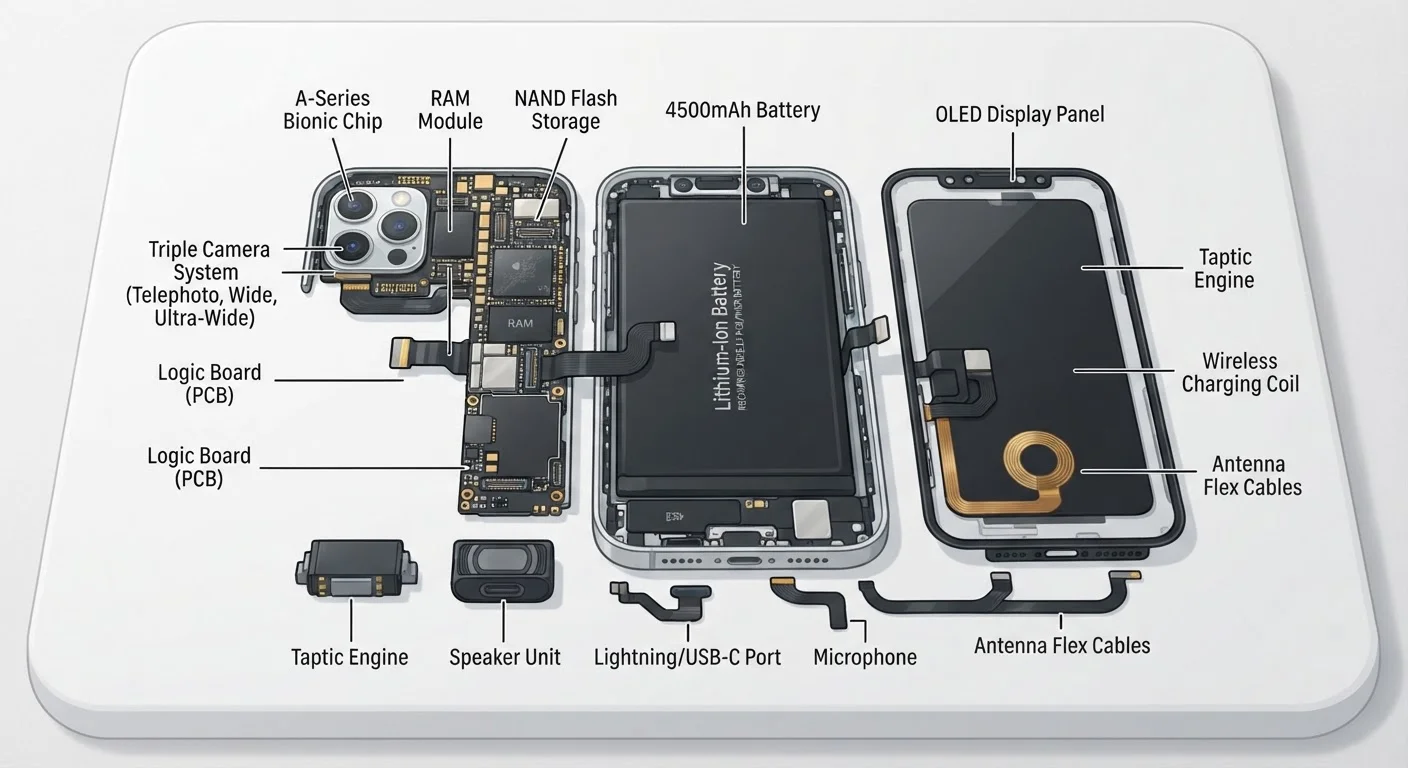
Photo: HorizonMetric.com | One Destination For Everyday Insights editorial
—— In This Article
Why Knowing What's Inside Actually Matters
When you pick up a phone and read that it has a "3nm processor" or "LPDDR5 RAM," it's easy to glaze over. But those specs directly affect how fast your phone runs, how long the battery lasts, and whether it'll still feel snappy two years from now. You don't need an engineering degree to make sense of them — you just need the plain-English version.
This reference breaks down the core components found in virtually every modern smartphone, explains what each one does in everyday terms, and flags why it matters to you as a buyer or user. For a deeper look at one specific area, see our plain-English display dictionary for screen specs like refresh rate and brightness.
| SoC stands for | System-on-a-Chip — the main processor package |
| Typical smartphone RAM range | 6 GB – 16 GB in mainstream models (General industry range, varies by tier) |
| Common storage options | 128 GB, 256 GB, 512 GB, 1 TB |
| Battery capacity range | 3,000 – 5,000+ mAh for most phones (General industry range) |
| Baseband chip function | Manages cellular calls, texts, and mobile data |
| Number of sensors in a typical flagship | 10 or more distinct sensors (Varies by manufacturer) |
The Core Components, One by One
System-on-a-Chip (SoC)
The SoC — short for System-on-a-Chip — is the brain of your phone. It bundles the main processor (CPU), graphics processor (GPU), and several other specialized engines onto a single piece of silicon roughly the size of a fingernail. When a manufacturer claims their phone has a faster chip, this is what they mean. A more capable SoC handles multitasking, gaming, photography, and AI features more smoothly — and typically does so while consuming less power.
RAM
RAM (Random Access Memory) is short-term working memory. It holds the apps and data your phone is actively using so they can be retrieved instantly. If you've ever had an app restart from scratch when you switch back to it, that's often a sign the phone ran low on RAM and had to clear it out. More RAM generally means smoother multitasking.
Storage
Unlike RAM, storage holds everything permanently — your photos, apps, music, and system software. Storage capacity is what manufacturers advertise in gigabytes (GB). One thing worth noting: a portion of that advertised space is already used by the operating system before you open the box. Our companion article on why 128GB fills up faster than you'd expect explains exactly where that space goes.
Battery
Smartphone batteries are measured in milliampere-hours (mAh) — a unit that reflects how much charge the battery can hold. A higher number generally means longer use between charges, but battery life also depends heavily on the SoC's efficiency, screen brightness, and network activity. Battery capacity alone doesn't tell the whole story.
Baseband Chip
The baseband chip manages all wireless communication that involves a cellular network — calls, texts, and mobile data including 5G connectivity. It operates separately from the main SoC (though some manufacturers integrate it into the same package) and handles the complex radio signaling required to stay connected to towers.
Sensors and Supporting Hardware
Beyond the big-ticket chips, your phone contains an array of smaller components: an accelerometer (detects motion and orientation), a gyroscope (tracks rotation), a GPS receiver, ambient light sensors, proximity sensors, and often a barometer. Each serves a specific function — the proximity sensor, for instance, is what turns your screen off when you hold the phone to your ear.
SoC (System-on-a-Chip)
A single chip that combines the CPU, GPU, and other processing engines into one compact package. It's the central brain of a modern smartphone.
CPU (Central Processing Unit)
The part of the SoC that handles general computing tasks — running apps, loading web pages, and executing instructions. Often called the processor.
GPU (Graphics Processing Unit)
A specialized processor within the SoC focused on rendering visuals. It matters most for gaming, video playback, and UI smoothness.
RAM (Random Access Memory)
Short-term memory that holds currently active apps and data. It's wiped when the phone restarts and is separate from the storage where your files live permanently.
Baseband Chip
The component responsible for cellular radio communication — connecting your phone to a carrier network for calls, texts, and mobile internet.
mAh (Milliampere-hour)
The unit used to measure battery capacity. A higher mAh number generally indicates a larger battery, though real-world life depends on many other factors.
Accelerometer
A sensor that detects movement and orientation — used to rotate the screen when you tilt your phone or track steps in a fitness app.
Nanometer (nm) Node
A measurement describing how densely transistors are packed on a chip. A smaller number (e.g., 3nm vs. 7nm) generally means better performance and efficiency.
Putting It All Together
Every component works in concert. When you take a photo, the SoC processes the image, RAM holds it temporarily, the storage writes it permanently, and the battery powers all of it. Understanding which part does what makes it easier to interpret spec sheets honestly — and to recognize when a marketing claim is meaningful versus when it's just noise.
If you want to keep all these components running well over time, practical maintenance habits make a real difference. Our guide on keeping your devices running well for longer covers evidence-backed steps you can take today.
This article is for general informational purposes only. Specifications and component designs vary by manufacturer and product generation.

Technology Editorial Team
Technology Editorial Team is the collective byline for our editorial team and contributor network. Articles published under this byline or an editorial pen name are researched, written, and reviewed according to our editorial standards for clarity, consistency, and independence before publication.
View author profile