
Net Income vs. Gross Income: Why the Difference Matters for Budgeting
Budgeting from the wrong income figure is a surprisingly common mistake. Here's how to tell gross from net and why it changes your numbers.
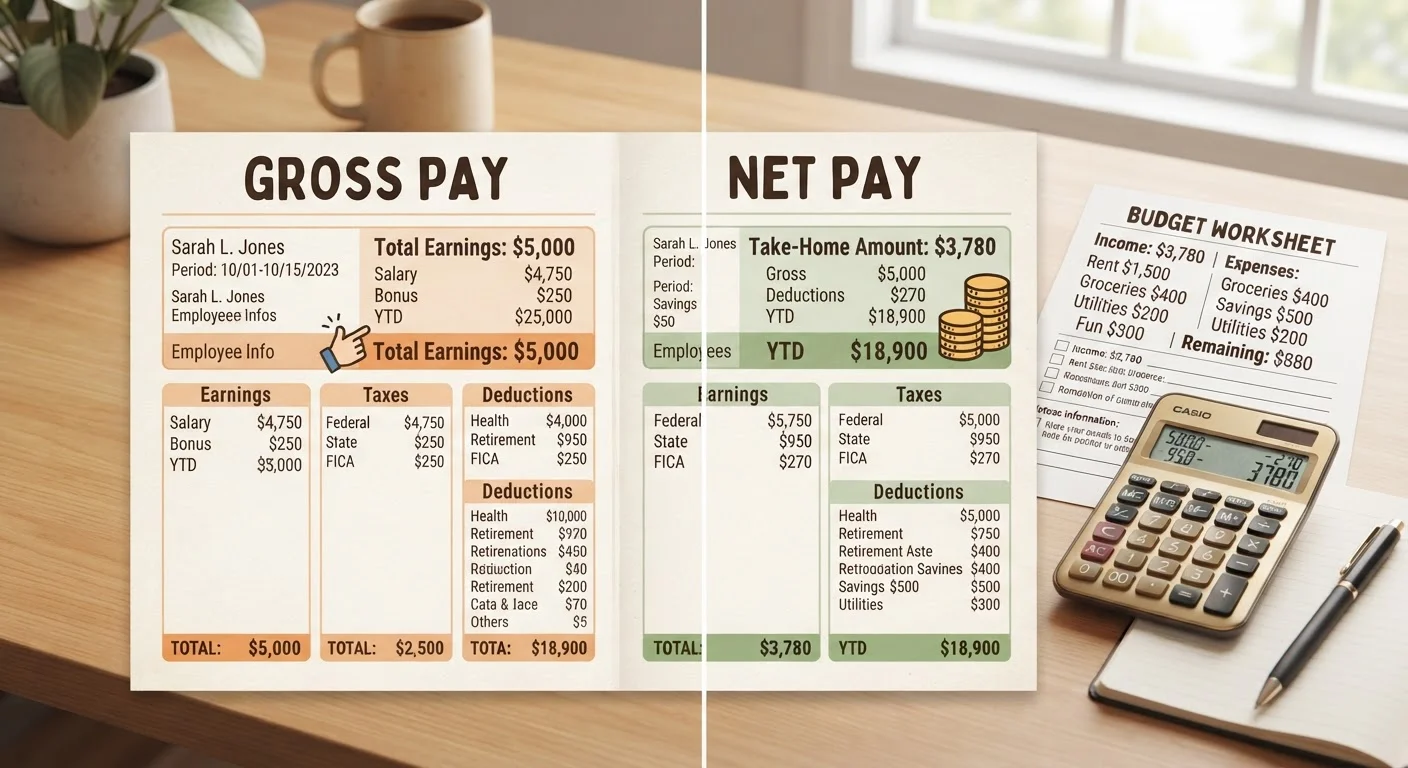
Photo: HorizonMetric.com | One Destination For Everyday Insights editorial
—— In This Article
Key Takeaways
- Gross income is your total pay before taxes and deductions are removed.
- Net income is what you actually take home and should always anchor your budget.
- Budgeting from gross income can overestimate your available funds by 20–35%.
- Deductions like taxes, health insurance, and retirement contributions reduce gross to net.
- Knowing both figures helps you evaluate job offers, benefits, and savings potential.
What Each Term Actually Means
When you see a salary listed in a job posting or on your offer letter, that figure is almost always your gross income — the total amount you earn before any deductions are applied. It's the headline number, but it's rarely the number that hits your checking account.
Net income — sometimes called take-home pay — is what remains after federal and state income taxes, Social Security and Medicare taxes (collectively called FICA), employer-sponsored health insurance premiums, retirement contributions, and any other pre-tax deductions are subtracted. For many workers, net income runs anywhere from 65% to 80% of gross income, depending on tax bracket, benefit elections, and deduction choices.
If you're new to building a personal budget, the fundamentals of personal budgeting are a helpful starting point before diving deeper into income calculations.
| Criterion | Gross Income | Net Income |
|---|---|---|
| Definition | Total earnings before deductions | Take-home pay after all deductions |
| Taxes applied | No — pre-tax figure | Yes — taxes already removed |
| Use for budgeting | No — overstates available funds | Yes — reflects spendable money |
| Use for loan applications | Yes — lenders typically use this | Rarely used by lenders |
| Use for salary comparisons | Yes — industry standard | Only after estimating deductions |
| Typical percentage of gross | 100% (the starting point) | Roughly 65–80% of gross |
Why Using the Wrong Figure Derails Your Budget
One of the most common early budgeting mistakes is planning expenses against gross income. If your annual salary is $60,000, that works out to $5,000 per month — but after taxes and typical deductions, your actual monthly take-home might be closer to $3,700 to $4,000. Budgeting against $5,000 leaves you short by hundreds of dollars every month before you've spent a cent.
This gap explains why some people feel perpetually behind despite earning a reasonable income. Understanding where your money actually goes each month becomes much clearer once you're working from the correct income baseline.
~30%
Average gap between gross and net pay
For a median U.S. household, combined federal taxes, FICA, and common benefit deductions typically reduce gross pay by roughly 25–35%, though the exact figure varies by income level and benefit elections.
~50%
Workers who report budgeting by gross pay
Surveys by financial literacy organizations have consistently found that a significant share of Americans plan their monthly budgets using their stated salary rather than their actual take-home pay.
The practical fix is straightforward: look at your most recent pay stub and find the "net pay" or "take-home" line. That is the only number you should use when allocating money to rent, groceries, savings, or any expense category. If your income varies — for example, if you're a freelancer or hourly worker with irregular hours — average your last three months of net deposits to establish a workable baseline.
Breaking Down What Sits Between Gross and Net
Understanding the deductions that bridge gross and net income gives you more control than simply accepting whatever appears on your pay stub. These deductions generally fall into two categories:
- Mandatory deductions: Federal income tax, state income tax (where applicable), Social Security tax (6.2% of wages up to an annual wage base), and Medicare tax (1.45% of all wages). These are non-negotiable.
- Voluntary pre-tax deductions: Contributions to a 401(k) or 403(b) retirement plan, health insurance premiums, flexible spending account (FSA) or health savings account (HSA) contributions, and similar benefits. These reduce your taxable income, which lowers the taxes you owe — but they also reduce your net take-home pay.
This distinction matters when you're weighing benefit elections during open enrollment. Increasing your 401(k) contribution by 2% lowers your net pay, but it also reduces your taxable income and builds retirement savings. The tradeoff is worth understanding explicitly rather than encountering it as a surprise on your next paycheck.
Pre-Tax Deductions Lower Your Tax Bill
Contributions to a 401(k), FSA, or HSA are deducted from your gross pay before income taxes are calculated. This means they reduce the amount of income subject to tax, which can lower your overall tax bill — even though they also reduce your net take-home pay. Running the numbers on pre-tax benefits is a worthwhile exercise when reviewing your pay stub or open enrollment options.
Once you have a clear handle on your net income, you can explore methods like zero-based and percentage-based budgeting to decide how to allocate it each month.
Putting Both Numbers to Work
There's a practical role for each figure depending on what you're trying to accomplish. Use gross income when comparing job offers, estimating loan eligibility, or calculating whether a raise keeps pace with inflation. Use net income for every spending and saving decision in your actual budget.
A useful habit: after any change to your income or benefits — a new job, a raise, a change in health plan, or a shift in retirement contributions — pull a fresh pay stub and recalculate your net. Salaries change, tax withholding adjusts, and benefit elections shift from year to year. Your budget should reflect your current reality, not a stale estimate.
If any persistent myths are making budgeting feel more restrictive or complicated than it needs to be, it's worth reviewing common budgeting myths that keep people from starting. Often the barrier isn't your income — it's working from the wrong set of assumptions.
This article is for general informational and educational purposes only and does not constitute personalized financial or tax advice. For guidance specific to your situation, consider consulting a licensed financial adviser or tax professional.

Finance Editorial Team
Finance Editorial Team is the collective byline for our editorial team and contributor network. Articles published under this byline or an editorial pen name are researched, written, and reviewed according to our editorial standards for clarity, consistency, and independence before publication.
View author profile