
The Real Cost of Carrying a Credit Card Balance Month to Month
Interest compounds quietly. This explainer walks through how revolving credit card debt grows over time and what it means for your household finances.
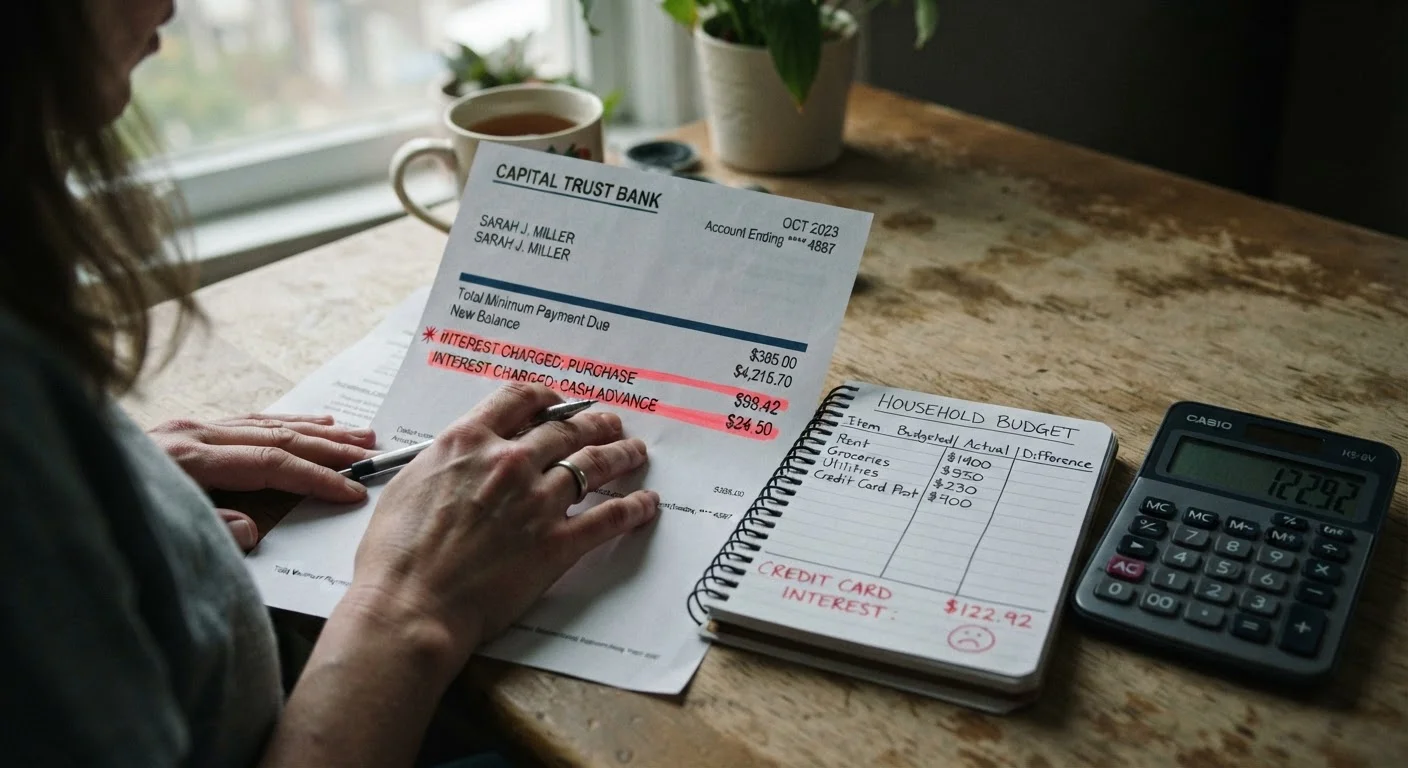
Photo: HorizonMetric.com | One Destination For Everyday Insights editorial
—— In This Article
Key Takeaways
- Credit card interest compounds daily, meaning unpaid balances grow faster than the stated annual rate suggests.
- Paying only the minimum each month dramatically extends how long it takes to eliminate a balance.
- The average credit card APR in the U.S. has exceeded 20% in recent years, making carried balances costly.
- Interest paid on a credit card balance cannot be invested or used for savings goals — it is a direct financial drain.
- Even small increases in monthly payments can significantly reduce total interest paid and payoff time.
How Carried Balances Accumulate Interest
When you swipe your credit card and pay the full statement balance by the due date, you pay no interest — that's the grace period working in your favor. But when any portion goes unpaid, the grace period disappears and your issuer begins charging interest on the outstanding amount, every single day.
Credit cards compound interest differently from a simple annual charge. Your issuer divides your APR by 365 to produce a daily periodic rate, then multiplies that rate by your average daily balance. On a $2,500 balance at 22% APR, that's roughly $1.51 added to your balance every day — before you've made a single new purchase. By month's end, you owe not just the original $2,500 but the principal plus accumulated interest, and next month's interest calculation starts from that higher number.
This is what makes credit card debt behave differently from a fixed loan. The balance is not static — it's a growing figure unless you actively outpace the daily interest accumulation with your payments.
20%+
Average U.S. credit card APR
Federal Reserve data has shown average credit card interest rates consistently exceeding 20% in recent years, among the highest in decades.
$5,000+
Typical revolving balance for indebted U.S. households
Federal Reserve consumer credit data indicates that households carrying revolving credit card balances often owe more than $5,000 at any given time.
1–2%
Typical minimum payment as share of balance
Most major card issuers set minimum payments at roughly 1–2% of the outstanding balance or a small flat dollar amount, whichever is greater.
The Minimum Payment Trap
Card issuers are required to disclose on your monthly statement how long it will take to pay off your balance if you only make minimum payments. That number is often startling — and for good reason.
Minimum payments are typically calculated as a small percentage of your balance (often around 1–2%) or a flat dollar floor, whichever is higher. Because the minimum shrinks as your balance shrinks, you're essentially always paying just enough to keep the interest from overwhelming you — but rarely enough to make serious headway on the principal.
Consider a $3,500 balance at 21% APR with a 2% minimum payment. In the early months, the minimum might be $70. Of that, roughly $61 covers interest, leaving about $9 applied to the actual debt. At that pace, the payoff timeline stretches to more than 20 years, with total interest paid far exceeding the original balance.
A Simple Rule: Pay More Than the Minimum
Even adding $25–$50 above the minimum payment each month can meaningfully shorten your payoff timeline and reduce total interest paid. If your budget allows, aim to pay the full statement balance each cycle to eliminate interest charges entirely. When that's not possible, every extra dollar directed at the principal still works in your favor.
To understand how this dynamic compares to the wealth-building side of compounding — where interest works for you instead of against you — see our explainer on how compound interest drives long-term wealth.
The Real-Dollar Impact on Your Household Budget
Interest charges don't show up as a line item in most family budgets, but they function like an invisible recurring expense. Every dollar sent to a card issuer as interest is a dollar unavailable for groceries, an emergency fund, or a retirement contribution.
According to the Federal Reserve, the average revolving credit card balance for U.S. households carrying debt has consistently exceeded $5,000 in recent years. At a 22% APR, that balance generates more than $1,100 per year in interest — before any new charges are added. That's money that leaves the household with nothing tangible to show for it.
The opportunity cost compounds this problem. Dollars lost to interest could otherwise be directed toward savings goals. Even modest additional monthly payments can sharply reduce the total interest paid. Increasing a payment from $70 to $150 on that same $3,500 balance at 21% APR would cut payoff time from over 20 years to roughly 2.5 years and save thousands of dollars in interest.
For a deeper look at habits that can stall your repayment progress once you're committed to paying down debt, see patterns that quietly undermine debt payoff.
Building a Path Forward
Understanding the mechanics of credit card interest is the first step; acting on that understanding is what changes your financial picture. There are two widely recognized structured approaches to paying down multiple debts: the debt avalanche (targeting highest-interest balances first) and the debt snowball (starting with smallest balances for psychological momentum). Our guide to the debt avalanche vs. debt snowball breaks down how each works and what it costs over time.
Before choosing a strategy, it helps to clear up any misconceptions you may have absorbed along the way. For example, many people believe minimum payments are an acceptable long-term approach, or that closing old cards helps their finances. Common debt myths can actively derail repayment — separating fact from fiction matters.
If you're ready to move beyond strategy selection and into action, approaches associated with faster, sustained debt reduction offers practical, research-grounded guidance on what actually moves the needle.
When to Seek Professional Help
If your credit card balances feel unmanageable or your minimum payments are consuming a significant share of your monthly income, a nonprofit credit counseling agency — such as one affiliated with the National Foundation for Credit Counseling (NFCC) — can help you assess your options. A licensed financial counselor can review your full picture and suggest a repayment path tailored to your circumstances. This article provides general education only and is not a substitute for personalized advice.
This article is for general informational purposes only and does not constitute personalized financial or legal advice. Please consult a qualified financial professional for guidance specific to your situation.
Frequently Asked Questions

Finance Editorial Team
Finance Editorial Team is the collective byline for our editorial team and contributor network. Articles published under this byline or an editorial pen name are researched, written, and reviewed according to our editorial standards for clarity, consistency, and independence before publication.
View author profile