
Common Myths About Insulation That Cost Homeowners Money
Does more insulation always mean lower bills? Does older insulation still work? Separating fact from fiction for everyday homeowners.
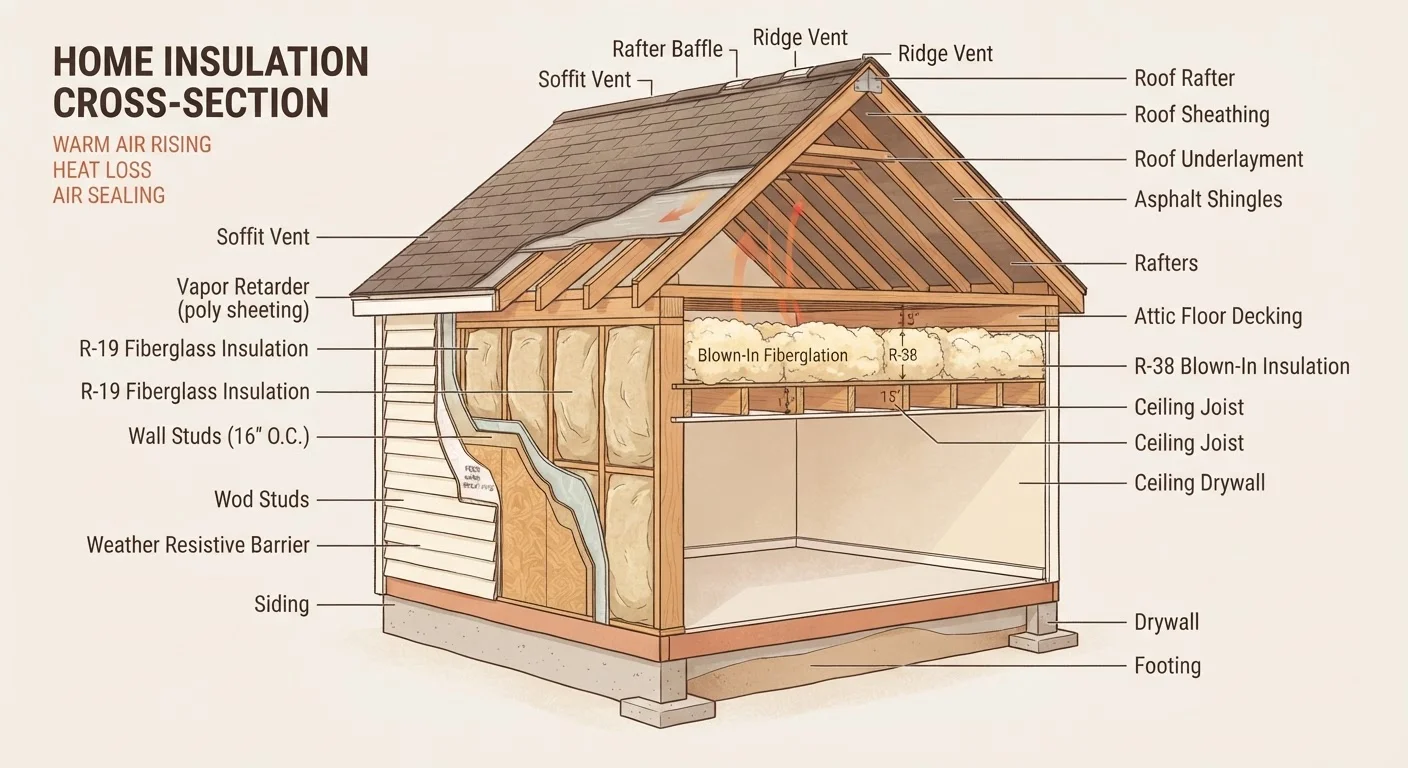
Photo: HorizonMetric.com | One Destination For Everyday Insights editorial
—— In This Article
Key Takeaways
- More insulation is not always better — the right R-value for your climate zone matters most.
- Old insulation loses effectiveness over time and may need replacement or supplementing.
- Insulation alone cannot fix air leaks; sealing gaps is equally essential for energy savings.
- Vapor barriers are not universally required and can cause moisture problems if misapplied.
- Professional energy audits help identify exactly where your home is losing heat or cool air.
Why Insulation Myths Are Expensive
Insulation is one of those home systems that most homeowners never see — and that invisibility breeds misunderstanding. Decisions based on half-truths or outdated advice can result in wasted money on unnecessary materials, missed energy savings, or even moisture damage that costs thousands to repair.
Misconceptions about insulation are surprisingly common, even among experienced DIYers. Separating fact from fiction here isn't just an academic exercise — it's a genuine money-saver. Much like the financial myths covered in our piece on budgeting misconceptions, insulation myths tend to keep people from taking the right action at the right time.
The myth-busting pairs below address the most common — and most costly — misconceptions homeowners encounter when thinking about insulation upgrades.
Myth
Adding more insulation will always lower your energy bills.
Fact
Insulation follows the law of diminishing returns — there's an optimal R-value for your climate zone, and going well beyond it yields minimal additional savings.
R-value measures resistance to heat flow. Each climate zone in the U.S. has a recommended R-value range for attics, walls, and floors. Once you reach that target, adding more insulation provides increasingly smaller energy benefits while adding real cost. The key is hitting the right target for your specific location, not simply piling on more material.
Myth
Old insulation is still doing its job as long as it looks intact.
Fact
Insulation degrades over time — fiberglass can sag and compress, cellulose can settle, and any type can absorb moisture or become contaminated with mold or pests.
Appearance alone is a poor indicator of performance. Compressed fiberglass batts lose R-value because it's the trapped air — not the material itself — that insulates. Cellulose, made from recycled paper, can settle by 20% or more over the years, leaving gaps. If your insulation is several decades old, or if you've had any roof leaks or pest activity, have it professionally evaluated before assuming it's still working effectively.
Myth
Insulation seals your home against drafts on its own.
Fact
Insulation slows heat transfer but does not stop air movement. Gaps, cracks, and penetrations must be sealed separately to prevent drafts.
Think of insulation as a sweater and air sealing as a windbreaker. A sweater alone doesn't stop wind; you need both layers working together. Common air leak points include around recessed lights, plumbing penetrations, attic hatches, and where walls meet the foundation. Sealing these gaps with caulk or spray foam before installing insulation dramatically improves overall performance and is typically one of the most cost-effective improvements a homeowner can make.
Myth
You always need a vapor barrier when insulating.
Fact
Vapor barriers are required in some climates and locations but can actually cause moisture damage if installed incorrectly or in the wrong climate zone.
Vapor barriers (technically vapor retarders) are designed to slow moisture migration. In cold climates, they're often placed on the warm side of insulation to prevent interior moisture from reaching cold surfaces. But in hot, humid climates — or if placed on the wrong side — they can trap moisture and promote mold growth. Local building codes exist for good reason here; always check your jurisdiction's requirements and consult a professional before installing any vapor control layer.
Myth
Insulating the attic is the only place that really matters.
Fact
While the attic is often the highest priority, crawl spaces, basement walls, and rim joists can account for significant heat loss and should not be overlooked.
Heat moves toward cold through every surface, not just the ceiling. Uninsulated rim joists — the wood framing that sits on top of your foundation walls — are a particularly common source of heat loss that's easy to miss. Crawl spaces contribute to cold floors and moisture problems. A whole-home approach that addresses multiple areas will outperform attic-only improvements in most homes.
What to Do After Clearing Up the Myths
Once you understand what insulation actually does — and doesn't do — the next step is a practical assessment of your home. Start with a visual inspection of your attic: if you can see your floor joists above the insulation, you likely need more. The U.S. Department of Energy publishes R-value recommendations by climate zone, which is the most reliable starting point for any upgrade decision.
For a comprehensive picture, consider scheduling a professional energy audit. Auditors use tools like blower-door tests and thermal cameras to pinpoint exactly where your home is losing conditioned air, so you spend money only where it counts. Pair any insulation upgrade with air sealing — caulk, spray foam, and weatherstripping work together to stop drafts that insulation alone cannot address. Our complete guide to weatherstripping walks through every sealing option in detail.
Finally, remember that insulation works best as part of a whole-home energy strategy. A smart thermostat can optimize your heating and cooling schedules, but it can't compensate for an under-insulated attic or a drafty crawl space. Tackle the building envelope first, then layer in technology for maximum impact.
Don't DIY Around Electrical or Hazardous Materials
If your home was built before 1980, existing insulation could contain asbestos or other hazardous materials. Do not disturb it without professional testing first. Similarly, insulating around knob-and-tube wiring requires an electrician's assessment — improperly covering this older wiring type with insulation is a fire hazard. When in doubt, hire a licensed contractor.

Home Editorial Team
Home Editorial Team is the collective byline for our editorial team and contributor network. Articles published under this byline or an editorial pen name are researched, written, and reviewed according to our editorial standards for clarity, consistency, and independence before publication.
View author profile