
Tracking Your Spending: Paper, Spreadsheet, or App?
Explore the trade-offs between analog and digital spending trackers to find the method most likely to stick for you.
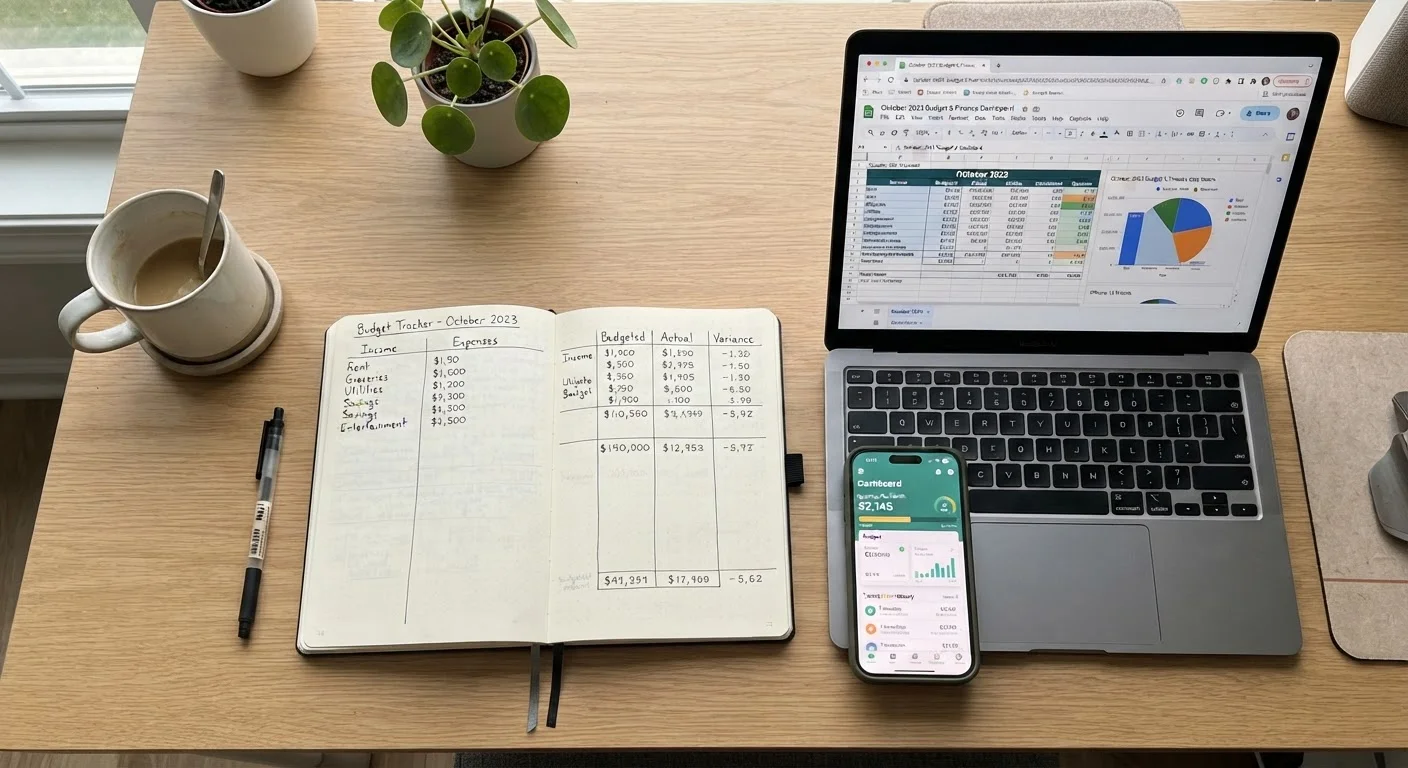
Photo: HorizonMetric.com | One Destination For Everyday Insights editorial
—— In This Article
Key Takeaways
- No single tracking method works for everyone — the best one is whichever you'll actually use consistently.
- Paper tracking reinforces mindful spending through the physical act of writing, but requires manual effort.
- Spreadsheets offer full customization and no subscription cost, but demand more upfront setup time.
- Budgeting apps automate data entry and provide instant visibility, though they involve privacy trade-offs.
- Switching methods mid-month is fine — adapting your system to your life beats abandoning tracking altogether.
Why Tracking Spending Matters
Most Americans have a general sense of their income but a fuzzy picture of where it actually goes. Research consistently shows that people who record their spending — regardless of method — make more intentional financial decisions than those who don't. Tracking closes the gap between what you think you spend and what you actually spend.
The challenge is sticking with it. That's why method matters. A beautifully designed app you abandon after a week beats nothing by a very slim margin. The goal of this comparison is to help you find the approach most likely to become a habit. Once your tracking is consistent, you can use a monthly budget audit checklist to convert that data into real financial progress.
This article is for general educational purposes and does not constitute personalized financial advice. Consult a qualified financial professional for guidance specific to your situation.
Paper: Slow, Deliberate, Effective
Writing purchases down by hand is one of the oldest budgeting techniques — and one used in methods like envelope budgeting. The friction of manually logging each transaction is actually a feature, not a bug: it forces a moment of awareness every time money leaves your wallet or account.
Advantages:
- Zero cost — any notebook works
- No privacy concerns; your data stays offline
- The physical act of writing reinforces memory and intention
- Completely flexible format
Drawbacks:
- Time-consuming, especially with many small transactions
- Easy to forget to log; no reminders
- Totaling and categorizing requires manual math
- Not portable in the same way a phone is
Paper tracking works especially well for people who are trying to break overspending habits or who find screens distracting. It also pairs naturally with cash-based systems.
Start With Just One Week
If you're new to tracking, commit to logging every transaction for just seven days — using whichever method feels lowest-friction right now. A single week of honest data often reveals surprising patterns. You can refine your method or switch tools once the habit is established.
Spreadsheets: Flexible Control Without the App
A well-built spreadsheet sits between paper and apps — it's digital, so math is automatic, but you remain in full control of what you track and how. Free tools like Google Sheets or Microsoft Excel allow you to build a template once and reuse it monthly.
Advantages:
- Highly customizable to your specific budget categories
- Formulas handle arithmetic; no manual totaling
- No ongoing subscription cost
- Data stays in your account — you decide what connects to what
- Easy to build charts for visual trends over time
Drawbacks:
- Requires initial setup time and some comfort with formulas
- Entries are still manual — you must log each transaction yourself
- Mobile experience can be clunky compared to dedicated apps
Spreadsheets are a strong fit for people who enjoy data and want a system tailored to their household. If your spending is irregular — freelance income, variable grocery budgets, travel — the ability to add custom columns is a real advantage. Speaking of travel, consistent tracking is one of the habits that prevent overspending on trips; see why travelers overspend and how to stay on track.
| Paper | Spreadsheet | App | |
|---|---|---|---|
| Cost | Free | Free (tool) / no subscription | Free–$15+/month |
| Setup effort | Minimal | Moderate (build template) | Low (account linking) |
| Data entry | Fully manual | Fully manual | Mostly automated |
| Privacy | Highest — fully offline | High — no bank linking needed | Lower — credentials shared |
| Customization | Unlimited | Unlimited | Limited to app features |
| Best for | Mindful spenders | Data-driven budgeters | On-the-go trackers |
Apps: Automation at a Privacy Cost
Budgeting apps automate the most tedious part of expense tracking — data entry — by syncing directly with your bank and credit card accounts. Transactions appear categorized (sometimes imperfectly) within hours.
Advantages:
- Near-real-time visibility into spending without manual logging
- Push notifications can flag unusual charges or approaching budget limits
- Most apps visualize spending by category automatically
- Accessible anywhere via smartphone
Drawbacks:
- Requires sharing bank login credentials or linking accounts via a third-party service
- Many apps charge a monthly or annual subscription fee
- Automatic categorization is often inaccurate and needs review
- App shutdowns or account errors can disrupt your tracking history
Review App Permissions Carefully
When linking a budgeting app to your bank accounts, read the privacy policy to understand how your transaction data is stored, shared, or used for marketing. Some apps use aggregator services that hold login credentials on your behalf. If you're uncomfortable with that arrangement, a spreadsheet or paper method may better fit your privacy preferences.
Apps tend to suit people who want low daily effort and don't mind trading some data privacy for convenience. If automation appeals to you more broadly, it's worth understanding how automating your finances shapes saving behavior — the same mindset applies. Whatever method you choose, applying your tracking data to real goals is the next step; the monthly budget audit for saving and debt shows you how.
1 in 3
Americans track spending regularly
Surveys by the National Foundation for Credit Counseling have consistently found that a minority of U.S. adults maintain a written or digital budget.
~20%
Average spending underestimation
Consumer behavior research suggests people routinely underestimate their discretionary spending by roughly 15–25% without a formal tracking system.

Finance Editorial Team
Finance Editorial Team is the collective byline for our editorial team and contributor network. Articles published under this byline or an editorial pen name are researched, written, and reviewed according to our editorial standards for clarity, consistency, and independence before publication.
View author profile