
Sauté, Pan-Fry, and Stir-Fry: What Sets Them Apart
These three stovetop methods look similar but produce different results. Here's how heat, fat, and motion distinguish each technique.
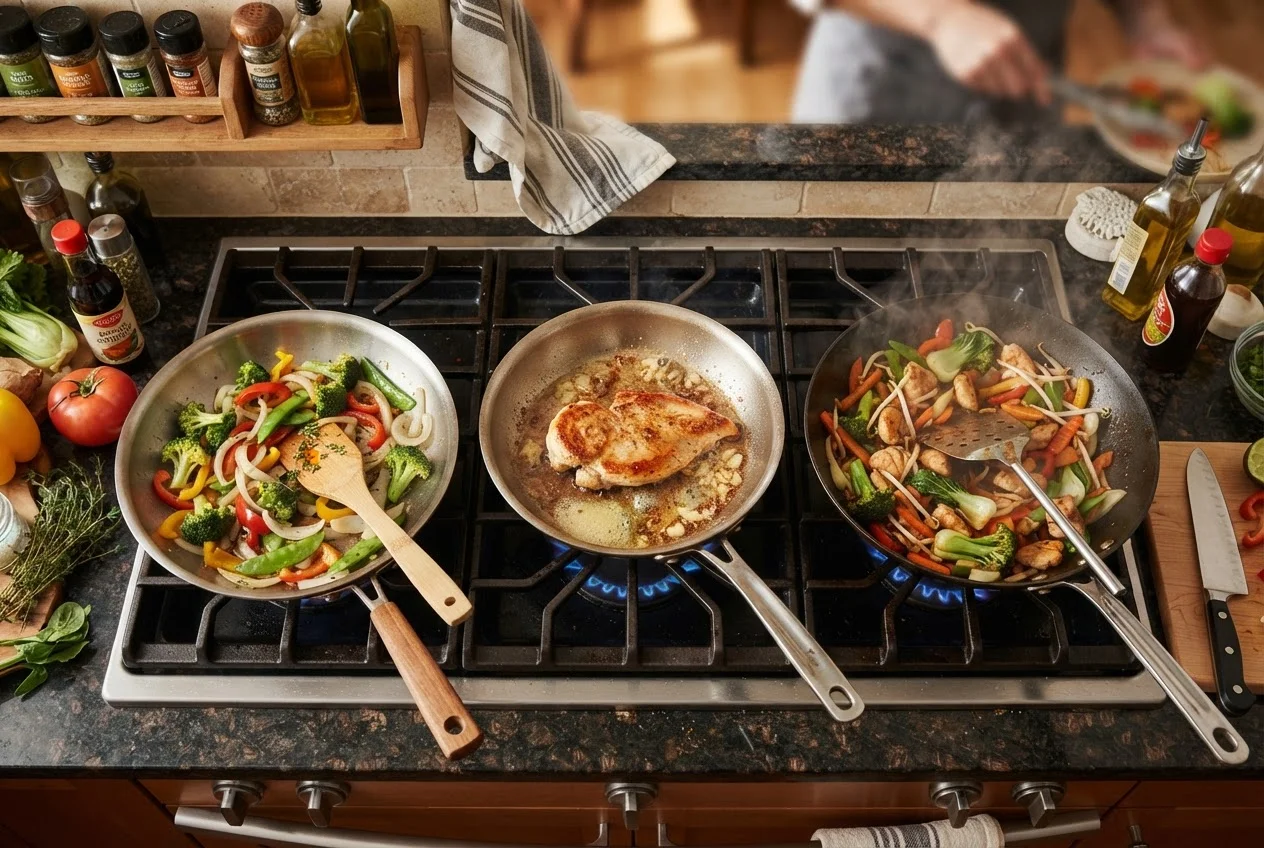
Photo: HorizonMetric.com | One Destination For Everyday Insights editorial
—— In This Article
Key Takeaways
- Sautéing uses high heat, a small amount of fat, and frequent movement for quick, tender results.
- Pan-frying uses moderate-to-high heat with more fat and minimal movement to build a crisp crust.
- Stir-frying is the fastest method, relying on very high heat, constant motion, and small, uniform pieces.
- The right pan and oil matter — each technique benefits from specific equipment and fat choices.
- Understanding these differences helps you match the method to your ingredient and desired texture.
Why These Three Methods Get Confused
Sautéing, pan-frying, and stir-frying all take place in a hot skillet or wok on your stovetop. All three use fat. All three cook food quickly. That surface-level similarity is why beginners often use the terms interchangeably — and why dishes sometimes turn out mushier, greasier, or less browned than expected.
The differences come down to three variables: heat level, amount of fat, and how much you move the food. Nail those three, and you can confidently choose the right technique for any ingredient. For a broader map of how stovetop methods compare to oven and liquid-based cooking, see The Foundational Cooking Methods.
Sautéing: High Heat, Small Amount of Fat, Keep It Moving
The word sauté comes from the French verb meaning "to jump" — and that's a useful mental image. In sautéing, you use a small amount of fat (typically one to two tablespoons) in a wide, shallow pan over medium-high to high heat, and you keep the food moving — either by tossing or stirring frequently.
Because you're using so little fat and cooking so quickly, this method is ideal for small, tender cuts: diced onions, sliced mushrooms, shrimp, thin chicken strips, or cubed zucchini. The goal is to cook the food through while developing light browning on the surface.
A key pitfall: overcrowding the pan. Too much food at once drops the pan temperature, and your ingredients steam rather than sauté — turning limp and pale instead of lightly golden. Cook in batches when needed.
Dry Your Ingredients Before They Hit the Pan
Moisture is the enemy of browning in all three methods. Pat proteins dry with a paper towel and make sure vegetables aren't still wet from washing before they go into the pan. Surface water creates steam, which lowers pan temperature and prevents that desirable golden color from forming.
Pan-Frying: More Fat, Less Movement, Better Crust
Pan-frying uses more fat than sautéing — usually enough to come a quarter to halfway up the side of the food — and the food is mostly left alone once it hits the pan. That stillness is intentional: it allows a proper crust to form through a process called the Maillard reaction, where proteins and sugars on the surface brown and develop deep flavor.
This method suits thicker, denser cuts that benefit from a crisp exterior: bone-in chicken thighs, fish fillets, pork chops, or breaded cutlets. Heat is typically medium-to-medium-high — hot enough to crisp the surface without burning it before the interior cooks through.
Pan choice matters here. A heavy skillet like cast iron or stainless steel retains heat evenly, which is critical when a cold piece of meat hits the surface. Thin pans lose temperature quickly and can cause uneven cooking.
| Sautéing | Pan-Frying | Stir-Frying | |
|---|---|---|---|
| Heat Level | Medium-high to high | Medium to medium-high | Very high |
| Amount of Fat | Small (1–2 tbsp) | Moderate (¼–½ inch deep) | Small (1–2 tbsp) |
| Food Movement | Frequent tossing or stirring | Minimal — let it rest | Constant, rapid motion |
| Best Ingredient Size | Small, thin cuts | Thick, whole pieces | Uniform bite-sized pieces |
| Ideal Pan | Wide skillet | Heavy skillet (cast iron) | Wok or large skillet |
| Result | Light browning, tender | Deep crust, juicy interior | Crisp-tender, bright |
Stir-Frying: Maximum Heat, Constant Motion, Uniform Pieces
Stir-frying is the most intense of the three. It requires very high heat — higher than a typical home burner delivers at its best — and constant, rapid movement. The fat amount is modest (similar to sautéing), but the speed and heat set this method apart.
The technique originates in Chinese cooking and is ideally performed in a wok, whose sloped sides allow ingredients to be tossed up and away from the hottest zone at the base. A large, flat skillet can approximate the method, though results differ slightly.
For stir-frying to work, ingredients must be cut small and uniformly — thin strips, small cubes, or bite-sized pieces — so everything cooks in under two minutes. Prep all your ingredients before the heat goes on; once the wok is hot, there's no time to stop and chop. The oil you choose matters too, since it needs a high smoke point. Matching your oil to the method is especially important at stir-fry temperatures.
Choosing the Right Method for Your Ingredient
A quick way to choose: think about the size, density, and texture goal of what you're cooking.
- Small, tender, or delicate? Sauté it — quick heat and movement preserve texture without overcooking.
- Thick, dense, and crust-worthy? Pan-fry it — the extra fat and stillness build the surface you're after.
- Uniformly cut and meant to stay crisp-tender? Stir-fry it — speed and high heat keep vegetables bright and proteins just cooked through.
These methods also pair naturally with different liquids. If you've ever deglazed a sauté pan with broth to build a quick pan sauce, you're already working with the principles explored in stock vs. broth. Understanding your liquids deepens your ability to finish dishes made with any of these dry-heat methods.
~300°F+
Minimum pan temp for Maillard browning
The Maillard reaction — responsible for browned, flavorful crusts — begins around 280–330°F on the food's surface, making pan temperature crucial to results.
2 min
Typical stir-fry cook time per batch
Most stir-fry recipes cook each ingredient batch in under two minutes over very high heat, which is why uniform cutting and pre-prepped mise en place are essential.

Food Editorial Team
Food Editorial Team is the collective byline for our editorial team and contributor network. Articles published under this byline or an editorial pen name are researched, written, and reviewed according to our editorial standards for clarity, consistency, and independence before publication.
View author profile