
Why Your Onions Aren't Caramelizing (And What's Really Happening in the Pan)
True caramelized onions take time and low heat. Understand the science behind the process and where most home cooks go wrong.
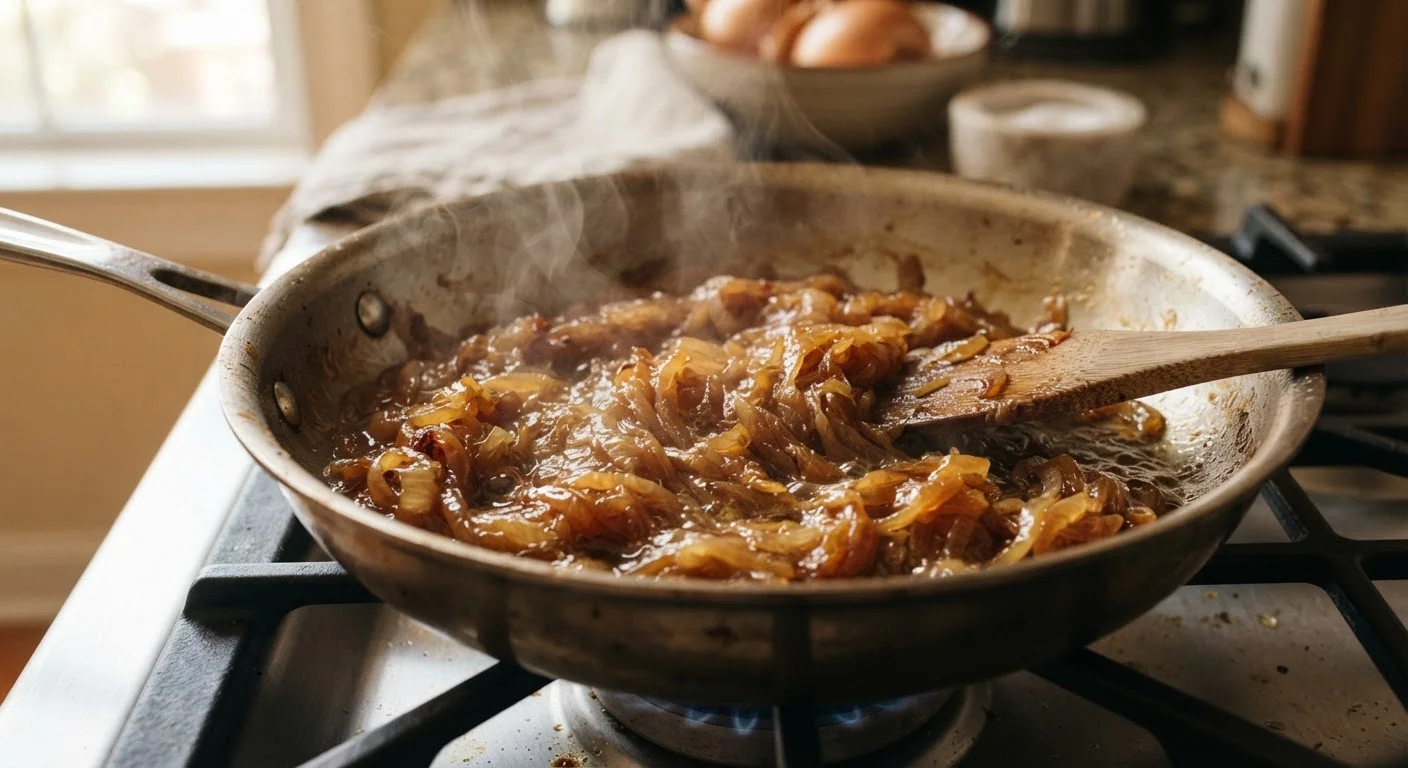
Photo: HorizonMetric.com | One Destination For Everyday Insights editorial
—— In This Article
Key Takeaways
- Caramelized onions genuinely require 40–60 minutes of low, patient heat — not 10 minutes.
- Two distinct chemical reactions — caramelization and the Maillard reaction — create that deep flavor.
- The most common mistake is using high heat, which burns the outside before the sugars transform properly.
- Crowding the pan traps steam and braises onions instead of browning them.
- A splash of water or stock can rescue onions that are sticking without ruining the process.
What's Actually Happening to Your Onions
When onions caramelize, two separate chemical processes are at work. The first is caramelization — the breakdown of natural sugars under heat, which produces hundreds of new flavor compounds and turns the onions a deep amber color. The second is the Maillard reaction, a chemical interaction between amino acids and reducing sugars that adds savory, roasted depth. Both require sustained moderate heat over a long period. Neither happens in 10 minutes.
Raw onions are roughly 5% sugar by weight, but that sugar is locked inside rigid cell walls. Heat slowly collapses those cells, releasing moisture first. That moisture must evaporate before browning can begin — which is exactly why caramelized onions take so much longer than most recipes suggest. Common cooking myths often oversimplify this process, leading home cooks to expect fast results that the chemistry simply can't deliver.
The Mistakes Keeping Your Onions Pale and Soggy
Understanding the science is only half the picture. Knowing where the process goes wrong will save you from repeating the same frustrating results. Here are the most common errors — and what to do instead.
Cranking the heat to speed things up.
Why it happens: Most home cooks are short on time and assume higher heat just means faster results.
Crowding too many onions into the pan.
Why it happens: Onions shrink dramatically during cooking, so adding a large volume seems reasonable at the start.
Stirring constantly — or not stirring enough.
Why it happens: Cooks either hover anxiously or set it and forget it, both of which disrupt the process.
Calling them done too early.
Why it happens: Softened, translucent onions look like progress and many recipes mislabel this stage as "caramelized."
Adding salt too late — or skipping it entirely.
Why it happens: Salt is often treated as a finishing step rather than a tool for controlling the cooking process.
40–60 min
Time needed for true caramelization
Culinary references consistently note that properly caramelized onions require at least 40 minutes over low to medium-low heat.
~75%
Water lost during caramelization
Onions are roughly 89% water by weight; during caramelization, a large portion evaporates, concentrating flavor and reducing volume significantly.
Setting Up for Success
A few deliberate choices before you even turn on the burner make a real difference. Choose a wide, heavy-bottomed pan — cast iron or stainless steel both work well — so onions spread out in a shallow layer and moisture escapes efficiently. A lid will trap steam and slow browning, so leave it off.
Slice onions uniformly, about ¼-inch thick. Thinner slices disintegrate; thicker ones cook unevenly. Start with medium heat to get the pan warm, then reduce to medium-low once the onions go in. Resist the urge to walk away entirely — a gentle stir every few minutes prevents hot spots from scorching. If the pan looks dry and onions are sticking, add a tablespoon of water or unsalted stock and scrape up the fond (the browned bits on the pan bottom). That fond is concentrated flavor, not a sign of failure.
Learning to read your stovetop's heat signals is one of the most useful skills you can build — it applies directly here, since burner output varies significantly between stoves. Reading a recipe with a cook's eye also helps: when a recipe says "caramelize onions," mentally budget at least 45 minutes rather than the 10 minutes sometimes printed.
Adding Sugar Won't Shortcut the Process
Some tips suggest adding a pinch of sugar to speed up browning. While this does increase color quickly, it can also cause burning before the onions have fully softened and developed their natural sweetness. It's better to let the onions' own sugars do the work over time — that's where the complex, layered flavor actually comes from.

Food Editorial Team
Food Editorial Team is the collective byline for our editorial team and contributor network. Articles published under this byline or an editorial pen name are researched, written, and reviewed according to our editorial standards for clarity, consistency, and independence before publication.
View author profile