
Knife Skills That Actually Matter for Home Cooks
You don't need professional training — but a few foundational cuts and habits make cooking faster, safer, and more consistent.
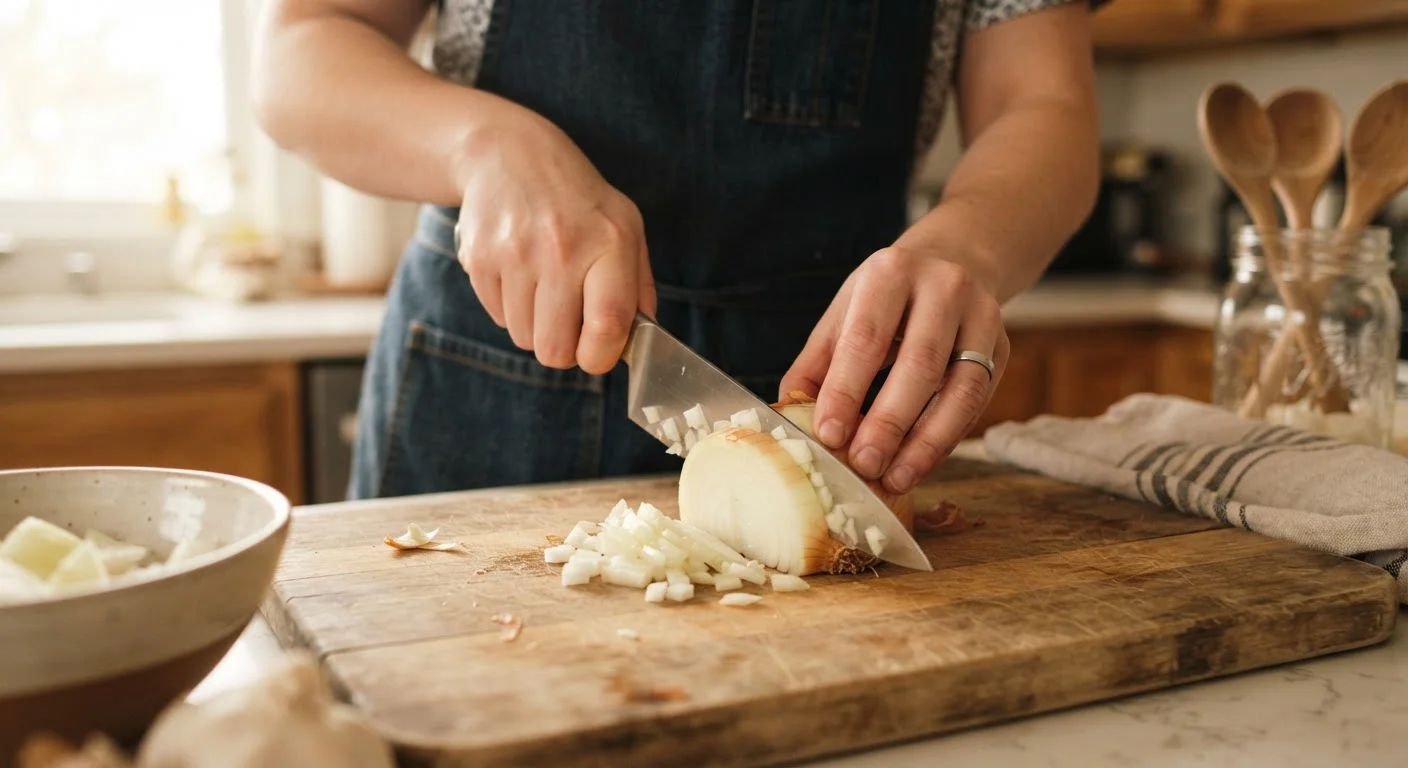
Photo: HorizonMetric.com | One Destination For Everyday Insights editorial
—— In This Article
Key Takeaways
- The pinch grip gives you more control and reduces the chance of slipping.
- A sharp knife is significantly safer than a dull one — dull blades require more force.
- Learning just three cuts — dice, julienne, and chiffonade — covers most home recipes.
- Consistent sizing matters more for evenness than speed at the cutting board.
- Your non-knife hand position protects your fingers on every single cut.
Why Knife Skills Matter More Than the Knife Itself
Many home cooks assume the secret to better prep is a fancier knife. In reality, technique makes a far bigger difference than the tool. A confident, controlled grip and a consistent cutting motion will outperform an expensive blade held awkwardly every time.
Good knife skills also make cooking genuinely more enjoyable. When your prep is fast, clean, and consistent, the rest of the recipe flows. You're less likely to rush, less likely to get hurt, and much more likely to end up with ingredients that cook evenly. If you've ever had vegetables where some pieces turned out mushy and others were still firm, uneven cutting is often the culprit.
For more foundational kitchen concepts, the mise en place guide explains how organizing your prep — including your cutting — reduces cooking stress significantly.
Knife Safety Is Non-Negotiable
Always cut on a stable surface. Place a damp kitchen towel under your cutting board to prevent sliding. Never try to catch a falling knife — step back and let it drop. Store knives in a block, on a magnetic strip, or with blade guards, never loose in a drawer.
The Techniques That Actually Come Up in Everyday Cooking
You don't need to master every classic French cut. Most home recipes draw on a short list of practical techniques. Focus on these and you'll be equipped for the vast majority of what a typical weeknight dinner demands.
Use the pinch grip as your default knife hold
Gripping the blade itself — thumb on one side, index finger on the other, just above the handle — gives you far more control than holding only the handle. It reduces hand fatigue and keeps the blade from twisting mid-cut, which is a leading cause of slipping.
Curl your guiding hand into a claw shape
The 'claw grip' — fingertips curled under, knuckles forward — keeps fingertips safely away from the blade edge. The flat side of the knife rests against your knuckles, naturally limiting how far the blade travels with each stroke.
Keep your knife sharp and hone it regularly
A dull knife requires more force to cut, making it far more likely to slip off a rounded vegetable and into your hand. Honing (using a honing steel) realigns the blade edge between uses; sharpening removes metal to restore a worn edge.
Master the basic dice before attempting decorative cuts
A standard dice — creating uniform cubes from a halved and sliced ingredient — is the foundation for soups, stews, sautés, and salads. Uniform pieces cook evenly, so nothing burns while something else stays raw.
Use a rocking motion for mincing herbs and aromatics
Rather than lifting the knife fully off the board with each stroke, keep the tip in contact with the board and rock the heel up and down across the ingredient. This is faster, more controlled, and puts less strain on your wrist.
Understanding the language around these techniques also helps. The cooking terms glossary covers related recipe vocabulary — like chiffonade and julienne — in plain English.
Quick Habits to Build Starting Today
You don't need a class to start improving. A handful of small, immediate changes can make your cutting board safer and your prep noticeably more efficient within a single cooking session.
“The most important thing in the kitchen is the knife. Everything else is a tool, but the knife is an extension of the cook's hand — and learning to use it well changes everything about how cooking feels.”
— Jacques Pépin, French-American chef, author, and culinary educator
Knife confidence pairs well with other kitchen fundamentals. Check out our piece on kitchen myths that trip up new cooks to see which instincts are worth trusting — and which ones to rethink. And once your prep is solid, tasting as you cook is the next skill that transforms how your finished dishes turn out.

Food Editorial Team
Food Editorial Team is the collective byline for our editorial team and contributor network. Articles published under this byline or an editorial pen name are researched, written, and reviewed according to our editorial standards for clarity, consistency, and independence before publication.
View author profile