
The World in a Bowl: Regional American Soups and What They Reveal About Local Identity
From New England clam chowder to gumbo and pozole, explore how regional soups carry cultural history and reflect the communities that made them.
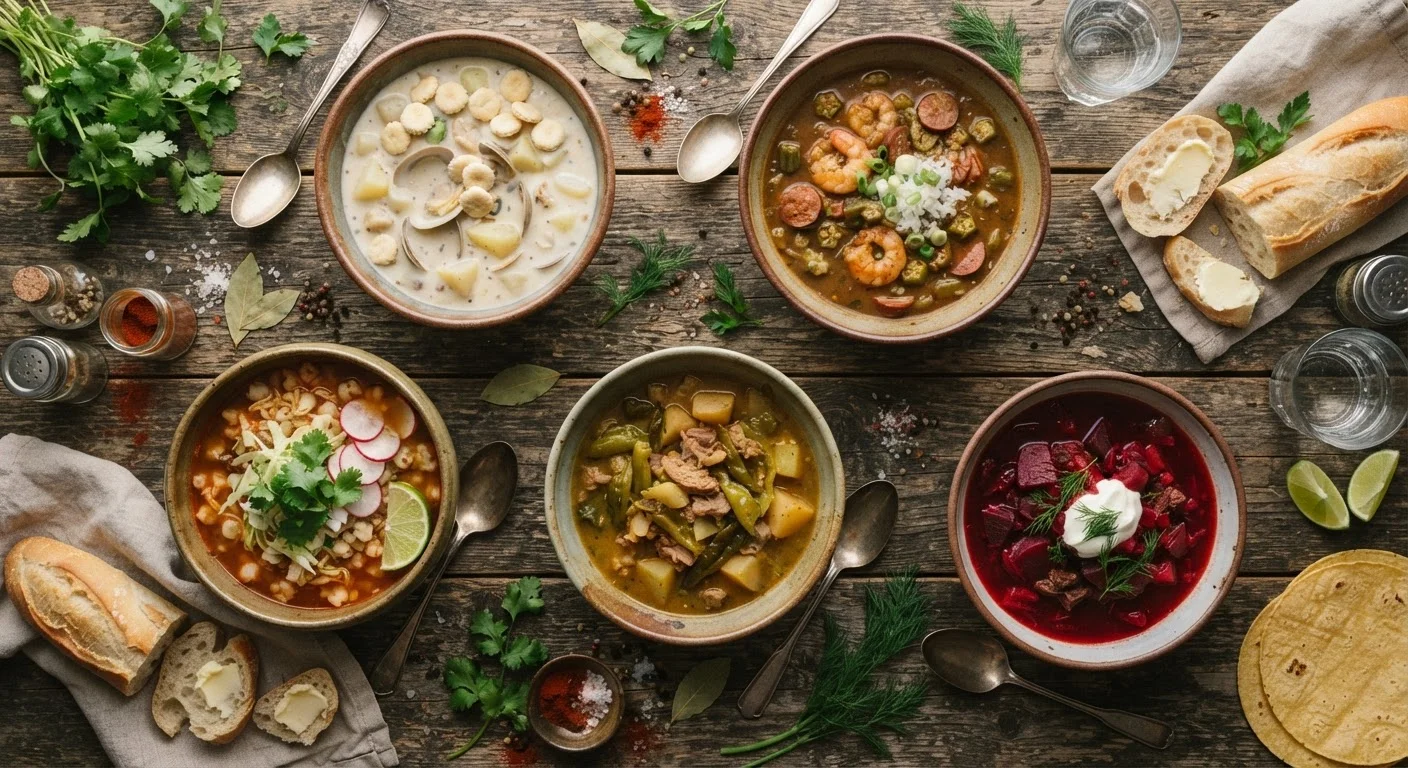
Photo: HorizonMetric.com | One Destination For Everyday Insights editorial
—— In This Article
Key Takeaways
- Regional American soups reflect immigration history, local ingredients, and cultural blending.
- Gumbo draws on West African, French, and Native American culinary traditions simultaneously.
- Pozole predates European contact and remains a living tradition in Mexican-American households.
- The base liquid — stock or broth — is often what distinguishes a soup's regional character.
- Soup traditions evolve continuously as communities move, mix, and adapt.
Why Soup Tells a Story
Soup is one of the oldest forms of cooking, and in America, it functions as something close to a living archive. A bowl of soup reflects who settled a region, what grew there, what animals were hunted or fished, and which food traditions survived the journey from somewhere else. Unlike many dishes that get polished for restaurants and cookbooks, soups tend to stay close to their origins — passed down through families, adjusted for what's on hand, and stubbornly local.
Understanding regional soups means understanding the communities that created them. It also means recognizing that American food culture has never been a single story. It's dozens of stories, simmering in separate pots, each one shaped by geography, migration, and memory. Whether you're a curious home cook or a road-tripper eating your way across the country (see our guide to regional food stops on an American road trip), these bowls are worth paying attention to.
350+
Distinct regional American dish traditions
Food historians estimate the U.S. has over 350 documented regional food traditions, many centered on soups and stews tied to specific landscapes.
~3,500 years
Age of nixtamalization technique used in pozole
Archaeological evidence suggests Mesoamerican cultures developed the nixtamalization process for hominy corn as far back as 1500 BCE.
64%
Americans who eat soup at least once per week
Campbell Soup Company consumer research has historically cited that roughly two-thirds of Americans consume soup at least weekly, particularly in fall and winter.
New England Clam Chowder: Fishermen, Colonists, and Cream
Few soups are as associated with a single place as New England clam chowder is with coastal Massachusetts, Rhode Island, and Maine. The dish traces its roots to 18th-century fishing communities, where chowder — likely derived from the French word chaudière, meaning a large cooking pot — was a practical way to cook fresh clams with salt pork, onions, and hardtack biscuits. Cream and potatoes came later as dairy farming expanded across the region.
What makes New England chowder distinct isn't just the cream base; it's the way geography shaped the ingredients. The cold, rocky Atlantic coast produced an abundance of clams, cod, and haddock, and the chowder tradition grew around what fishermen pulled from the water each day. Manhattan clam chowder — tomato-based and brothy — emerged later in the 20th century, and the two versions still inspire regional debate. That tension itself is part of the story.
Make Chowder More Flavorful
If you're making clam chowder at home, use the reserved clam liquor (the liquid inside canned or fresh clams) as part of your broth base. It adds a clean, briny depth that water or plain stock alone can't replicate. Add it gradually and taste as you go — it can be salty.
Gumbo: Louisiana's Most Layered Dish
Gumbo may be the most culturally complex soup in American cooking. Born in Louisiana, it draws simultaneously from West African, French Creole, Native American, and Spanish culinary traditions. The word gumbo itself is widely believed to derive from ki ngombo, a Bantu word for okra — the vegetable that West African enslaved people used as a thickener when they couldn't access traditional starches.
The dish has three possible thickeners: okra, filé powder (ground sassafras leaves, a technique from the Choctaw people), or a dark roux (the French-influenced base of flour and fat cooked low and slow). Many Louisiana cooks use more than one. The protein varies by subregion — seafood gumbo along the Gulf coast, chicken and andouille sausage inland. Each variation reflects local ecology and heritage in equal measure.
“Gumbo is a metaphor for Louisiana itself — a little bit of everything thrown together, and somehow it works. The roux is the soul of it, but the soul took centuries to develop.”
— Lolis Eric Elie, Food writer and author of 'Smokestack Lightning: Adventures in the Heart of Barbecue Country'
Gumbo resists standardization, which is precisely what makes it meaningful. There is no single "correct" recipe because no single community owns it. It belongs to Louisiana's complicated, layered history.
Pozole: A Southwestern Bowl With Ancient Roots
Pozole is a hominy-based soup with roots stretching back to pre-Columbian Mesoamerica, where it held ritual significance among Aztec and other indigenous communities. Hominy — dried corn kernels treated with an alkaline solution in a process called nixtamalization — has a distinctive chewy texture and mild flavor that absorbs the surrounding broth deeply.
In Mexican-American households across the Southwest and beyond, pozole is a celebratory dish: made for holidays, birthdays, and gatherings. It comes in three traditional colors — red (rojo), green (verde), and white (blanco) — each defined by its chile or tomatillo base. Toppings like shredded cabbage, radishes, dried oregano, and lime are added at the table, making the bowl interactive and personal.
The dried chiles at the heart of pozole — such as ancho, guajillo, and pasilla — are pantry staples in Mexican-American kitchens. If you want to understand the ingredient logic behind this soup, our piece on pantry staples in Mexican-American home cooking explains the role of each chile and how they build flavor.
When making pozole, toast your dried chiles in a dry skillet for 30–60 seconds before rehydrating them in hot water — it deepens their flavor dramatically without adding fat.
Toasting activates aromatic compounds in dried chiles that don't fully develop until exposed to direct dry heat, a technique used consistently in traditional Mexican cooking.
For a properly dark gumbo roux, commit to low heat and constant stirring for 30–45 minutes — rushing it with high heat risks burning, which makes the roux bitter and unusable.
The Maillard reaction that creates a chocolate-colored roux takes time; experienced Louisiana cooks treat this step as non-negotiable for authentic flavor depth.
Green Chile Stew and the High Desert Kitchen
New Mexico occupies a singular place in American food culture, and green chile stew is its most emblematic dish. Roasted Hatch green chiles — grown in the Hatch Valley and harvested late summer — form the flavor backbone of a stew that typically includes pork, potatoes, garlic, and a light broth. The smell of chiles roasting in late August is, for many New Mexicans, the smell of home.
The dish reflects the confluence of Pueblo, Spanish colonial, and later Anglo-American food traditions. Green chile stew is not a fixed recipe so much as a framework: every family adjusts the heat level, protein, and thickness. The chile itself changes year to year depending on rainfall and growing conditions — a reminder that this soup is tied to a specific landscape and season. For a deeper look at how regional growing conditions shape what ends up in your bowl, see our guide to seasonal produce calendars by region.
The Broader Mosaic: Other Regional Soups Worth Knowing
American soup culture extends well beyond these four landmarks. A partial inventory of what's out there:
- She-crab soup — A rich, cream-based bisque from the South Carolina Lowcountry, thickened with roe and seasoned with sherry. A direct product of the Atlantic blue crab fishery.
- Senate bean soup — Served daily in the U.S. Capitol dining room since the early 1900s, this navy bean and ham hock soup has become an unlikely symbol of American institutional cooking.
- Borscht — Eastern European Jewish immigrants brought this beet-based soup to New York City's Lower East Side in the late 19th century. It remains a fixture in Jewish delis and home kitchens across the Northeast.
- Chicken and dumpling soup — A comfort staple of the American South and Appalachia, where it reflects the tradition of stretching simple ingredients — a whole stewed chicken, flour, fat — into something deeply nourishing.
- Caldo de pollo — A Mexican-style chicken broth soup with vegetables and herbs, widespread across the Southwest and increasingly found nationwide wherever Mexican-American communities have settled.
Regional Soups Are Still Evolving
Many of the soups described here are not static museum pieces — they're actively changing. Immigrant communities continue to introduce new soup traditions across the country, and chefs in cities often blend regional styles in new ways. What counts as "authentic" is a conversation, not a fixed answer.
The base liquid matters enormously in all of these soups. If you've ever wondered why one bowl tastes flat and another has depth, the answer is often in the foundation. Our explainer on stock, broth, and bone broth differences breaks down exactly what sets each apart.
What These Bowls Have in Common
Despite their differences, regional American soups share a set of underlying patterns. They tend to use what's locally abundant — shellfish on the coasts, dried chiles in the desert Southwest, game and cultivated pork in the interior South. They're almost always economical, designed to feed many people from few ingredients. And they carry the imprint of migration: nearly every iconic American soup traces to a community that brought culinary knowledge from somewhere else and adapted it to a new environment.
Soups also evolve. Gumbo looks different in New Orleans today than it did two centuries ago. Pozole has traveled far from its original ritual context into everyday celebration. Green chile stew gets made in Denver and Chicago apartments by people who grew up in Albuquerque. This mobility is not dilution — it's the natural behavior of living food culture.
The next time you eat a bowl of regional soup, consider it a compressed form of history: who came here, what they brought, what they found, and how the two came together over heat and time.
Avoid Overcooking Seafood in Soups
When adding shellfish or delicate fish to soups, add them in the final 5–10 minutes of cooking. Overcooked clams, shrimp, or crab become rubbery and lose their flavor quickly. Heat carries over even after you remove the pot from the burner, so err on the side of slightly underdone.

Food Editorial Team
Food Editorial Team is the collective byline for our editorial team and contributor network. Articles published under this byline or an editorial pen name are researched, written, and reviewed according to our editorial standards for clarity, consistency, and independence before publication.
View author profile