
Home Fitness From the Ground Up: Equipment, Habits, and Progression
A comprehensive resource covering everything from setting up a workout space to structuring sessions and building lasting movement habits.
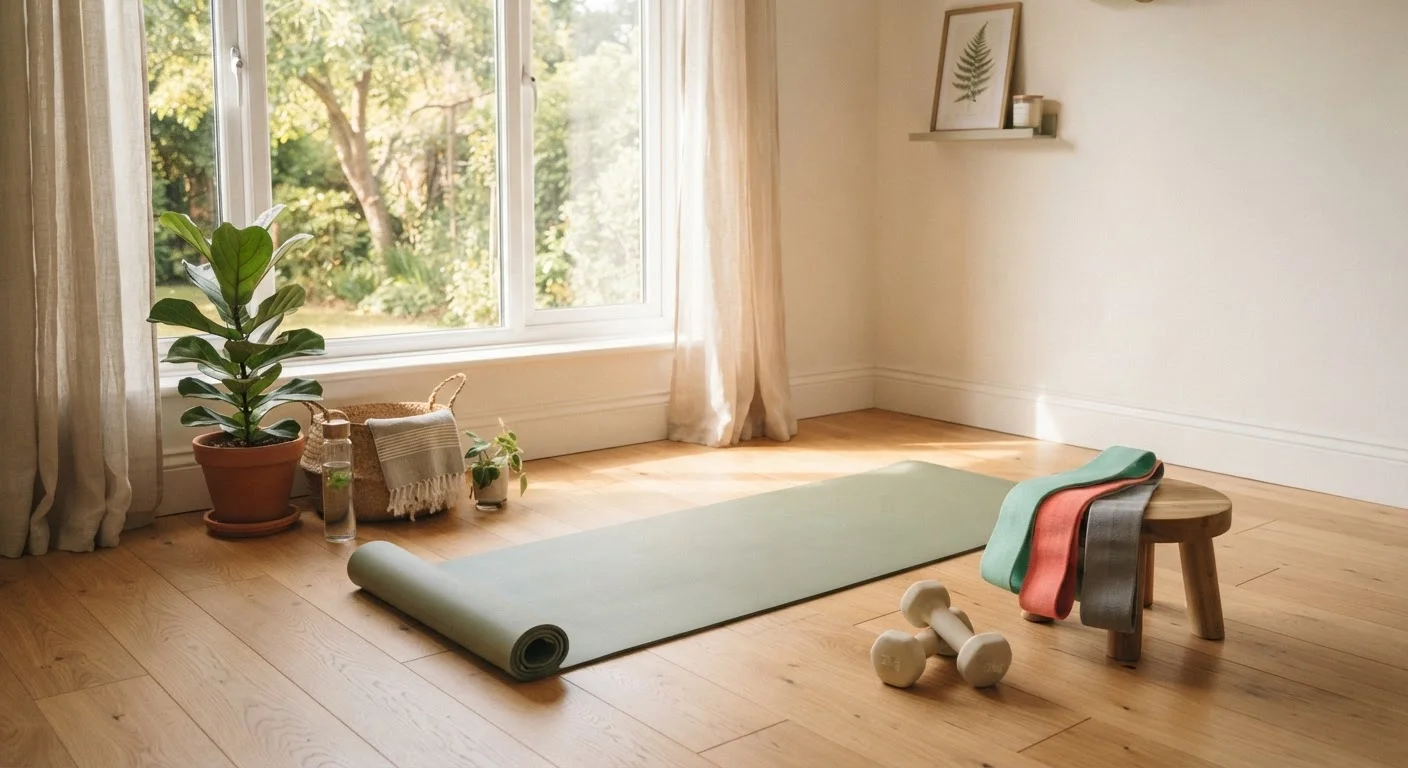
Photo: HorizonMetric.com | One Destination For Everyday Insights editorial
—— In This Article
Key Takeaways
- You don't need a dedicated room or expensive gear to build a consistent home fitness routine.
- Bodyweight movements alone can deliver meaningful strength and cardio benefits at any fitness level.
- Habit formation matters more than workout intensity, especially in the early weeks.
- Progression — gradually increasing challenge — is what drives long-term fitness improvement.
- Consistency over several months produces more lasting results than sporadic intense sessions.
Setting Up Your Space
One of the biggest barriers people cite before starting home workouts is not having the right space. The reality is that a clear floor area roughly the size of a yoga mat — about 6 by 2 feet — is enough to perform a full range of effective exercises. See our room-by-room look at where home workouts actually happen for specific ideas by room type.
When choosing your spot, look for three things: a non-slip surface, enough overhead clearance to raise your arms fully, and good ventilation. A cleared section of living room floor, a bedroom with furniture pushed aside, or even a backyard patch of grass all work well. You do not need mirrors, specialized flooring, or permanent equipment storage to get started.
Keep safety in mind: remove tripping hazards, secure any loose rugs, and make sure cords or furniture edges are out of the movement path. Good lighting reduces the risk of misjudging your position during floor exercises.
Designate Your Space Consistently
Using the same spot for every workout — even if it's a small living room corner — trains your brain to associate that location with exercise. This environmental cue makes it easier to start each session without relying purely on motivation. Keep your mat or any equipment visible rather than stored away to reduce friction.
Choosing the Right Equipment
Home fitness does not require a large equipment investment. Bodyweight training — using only your own body as resistance — is a well-supported approach for building strength, endurance, and mobility. Squats, push-ups, lunges, planks, and glute bridges require nothing at all and can be scaled for every fitness level.
If you want to expand your options, a few affordable additions offer significant versatility:
- Resistance bands: Lightweight, compact, and useful for adding challenge to lower-body and upper-body movements. Different resistance levels allow gradual progression.
- A non-slip mat: Useful for floor work, stretching, and yoga-style movements. Provides cushioning and helps define your workout zone.
- A stable chair or step: Already in most homes. Useful for incline push-ups, step-ups, tricep dips, and seated core work.
Avoid purchasing large or expensive equipment before establishing a consistent routine. Many home exercisers find that basic tools go unused after the novelty wears off. Start minimal and add only what a consistent practice genuinely calls for.
6 sq ft
Minimum floor space needed for most exercises
A standard yoga mat footprint is sufficient for the majority of bodyweight and resistance band movements used in home workouts.
2–3x
Recommended weekly training frequency for beginners
General physical activity guidelines from major health organizations suggest at least two days of muscle-strengthening activity per week for adults.
8 weeks
Typical timeframe for early habit formation
Research published in the European Journal of Social Psychology found that habit formation took an average of 66 days, with a range depending on the individual and behavior.
Structuring Your Workouts
A well-structured session does not need to be long. Research on exercise frequency consistently supports shorter, regular bouts of activity over infrequent marathon sessions. A practical structure for most beginners includes three parts: a brief warm-up, a main movement block, and a cooldown.
Warm-Up (5 minutes)
Gentle movement that raises your heart rate gradually and prepares joints for load. Examples: marching in place, arm circles, hip rotations, and slow bodyweight squats.
Main Block (15–25 minutes)
Choose three to five movements covering different muscle groups. Aim for a balance of lower body, upper body, and core. You might do three rounds of: squats, push-ups, reverse lunges, and a plank hold. Rest as needed between rounds — rest is a normal and necessary part of training, not a sign of failure.
Cooldown (5 minutes)
Slow, controlled stretches targeting the muscles you worked. Hold each stretch for 20–30 seconds. This supports recovery and flexibility over time.
Check our article on home fitness myths for a look at why you do not need to push to exhaustion to see results — a common misconception that derails many beginners early on.
Write your three planned exercises before the session starts, not during it. Decision fatigue mid-workout is a real barrier — having a written plan removes the friction of choosing what to do next.
Research on decision-making shows that having pre-committed choices reduces the mental effort required in the moment, making it more likely you will complete the full session.
If time is tight, do one round instead of skipping entirely. A ten-minute session done consistently outperforms a perfect hour-long session that never happens.
Exercise adherence research consistently finds that lowering the perceived barrier to starting — even to just a few minutes — is the most effective strategy for maintaining a long-term habit.
Building Lasting Movement Habits
The most effective workout routine is the one you actually do consistently. Habit research suggests that anchoring a new behavior to an existing routine — known as habit stacking — dramatically improves follow-through. For example, exercising immediately after your morning coffee or right before your evening shower creates a reliable trigger.
Start with a frequency you can genuinely sustain. Two to three sessions per week is a realistic and evidence-informed starting point for most beginners. Trying to exercise every day from week one is a common pattern that leads to burnout or injury. Explore the Wellness Habits hub for related strategies on building sustainable self-care routines.
Track your sessions simply — a paper calendar or a notes app works fine. Marking off completed workouts creates a visual record of progress that reinforces the habit loop. Missing one session is normal; the goal is to prevent one missed day from becoming several.
Rest Days Are Part of the Plan
Muscle and fitness adaptation largely occurs during recovery, not during the workout itself. Skipping rest days — particularly as a beginner — increases the risk of overuse injuries and burnout. Plan at least one to two full rest or gentle movement days per week, and treat them as a deliberate part of your program rather than a lapse.
Progressing Over Time
Progression is what separates a routine that keeps delivering results from one that plateaus. In practical terms, progression means gradually increasing the challenge of your workouts over time — adding a repetition, slowing the tempo of a movement, reducing rest time, or introducing a harder exercise variation.
A good general principle: once you can complete all sets and repetitions of a given exercise with good form and without significant struggle, it is time to introduce a small additional challenge. This is the concept of progressive overload applied to home training. Our companion article on exercise progressions covers specific movement progressions step by step.
Common home workout progressions include:
- Push-ups: Wall push-ups → incline push-ups → floor push-ups → slow-tempo floor push-ups
- Squats: Chair-assisted squats → bodyweight squats → pause squats → single-leg variations
- Planks: Forearm plank on knees → full forearm plank → extended hold time → plank with arm reaches
Also see common fitness myths that deserve a second look if you are concerned that home training cannot deliver meaningful results — the evidence tells a different story. For a broader approach to movement and exercise strategy, the Fitness & Movement hub is a useful ongoing resource.
This article is for general informational and educational purposes only and is not a substitute for personalized medical or fitness advice. Consult a qualified healthcare provider or certified fitness professional before beginning any new exercise program, especially if you have existing health conditions or concerns.

Beauty Editorial Team
Beauty Editorial Team is the collective byline for our editorial team and contributor network. Articles published under this byline or an editorial pen name are researched, written, and reviewed according to our editorial standards for clarity, consistency, and independence before publication.
View author profile