
Working Out at Home Versus Going to a Gym
Both approaches have real trade-offs. A balanced look at cost, accountability, variety, and social factors to help you think through the choice.
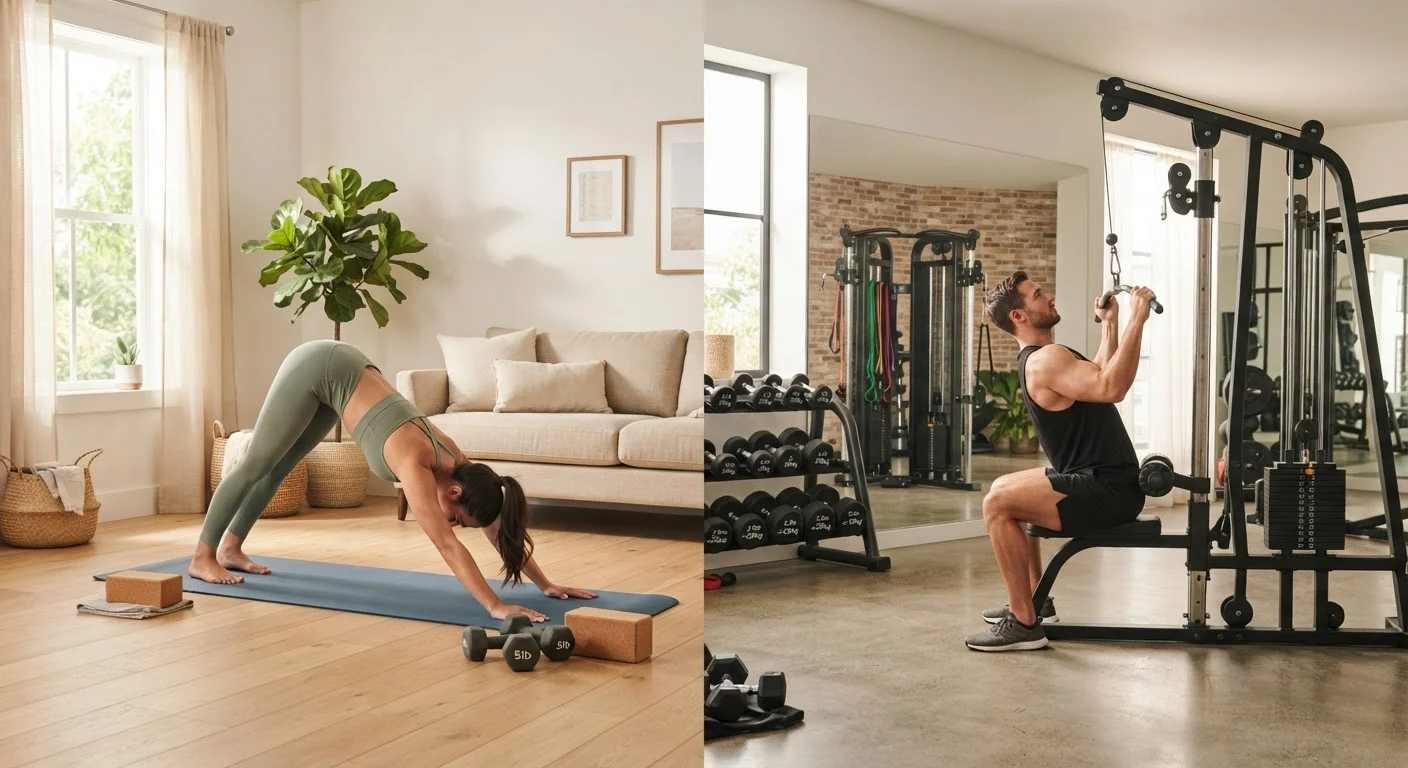
Photo: HorizonMetric.com | One Destination For Everyday Insights editorial
—— In This Article
Key Takeaways
- Home workouts eliminate commute time and membership costs, making consistency easier for busy schedules.
- Gyms offer equipment variety and social accountability that can be hard to replicate at home.
- Neither option is universally better — the right choice depends on your goals, budget, and personality.
- Many people find a hybrid approach — mixing home sessions with occasional gym visits — works best long-term.
No commute — removes a major barrier to consistency
Exercising at home means the only travel required is walking to another room. Studies on exercise adherence suggest that reducing logistical friction is one of the most reliable ways to maintain a habit.
Lower ongoing cost than most gym memberships
Home workouts can require little or no equipment, particularly for bodyweight-based routines. Even a modest set of resistance bands or dumbbells is typically a one-time cost.
Full schedule flexibility — exercise on your terms
Home training isn't limited by gym hours, class schedules, or holiday closures. This makes it especially practical for shift workers, parents, or anyone with irregular availability.
Private environment without social self-consciousness
Many people — especially beginners — feel more comfortable learning new movements without an audience. Training at home removes that pressure entirely.
Self-motivation is entirely your responsibility
Without external structure, it's easy for home sessions to get postponed or shortened. The environment offers distractions — household tasks, screens, other people — that gyms don't.
Limited equipment caps certain training goals
Building maximum strength through heavy compound lifting is difficult without a barbell and rack. Some fitness goals genuinely require the infrastructure a gym provides.
Space constraints affect exercise selection
Not every home has room for a full range of movement, jump training, or large equipment. Apartment dwellers may face noise restrictions that further limit options.
No immediate access to expert guidance
Gyms typically employ trainers who can correct form or advise on programming. At home, poor technique can go unnoticed longer, which may increase injury risk over time.
Why This Decision Matters More Than Most People Think
Choosing where you exercise might seem like a minor logistical question, but it significantly shapes whether you stick with a routine at all. Research consistently shows that convenience is one of the strongest predictors of exercise adherence — meaning the workout you'll actually do beats the theoretically optimal one you skip.
This article lays out the real trade-offs across cost, accountability, variety, and social dynamics so you can make a realistic choice for your life right now. If you're brand new to exercise, the beginner's guide to home fitness is a useful companion read.
No commute — removes a major barrier to consistency
Exercising at home means the only travel required is walking to another room. Studies on exercise adherence suggest that reducing logistical friction is one of the most reliable ways to maintain a habit.
Lower ongoing cost than most gym memberships
Home workouts can require little or no equipment, particularly for bodyweight-based routines. Even a modest set of resistance bands or dumbbells is typically a one-time cost.
Full schedule flexibility — exercise on your terms
Home training isn't limited by gym hours, class schedules, or holiday closures. This makes it especially practical for shift workers, parents, or anyone with irregular availability.
Private environment without social self-consciousness
Many people — especially beginners — feel more comfortable learning new movements without an audience. Training at home removes that pressure entirely.
The Case for Working Out at Home
Home training has moved well beyond the image of a dusty stationary bike in the corner. With minimal equipment — or none at all — it's possible to build real strength and cardiovascular fitness. Bodyweight training alone covers a broad range of fitness goals, and free online resources make programming accessible to everyone.
The clearest advantages are time and money. Eliminating a round-trip commute to a gym can reclaim 30–60 minutes per session. Over a week, that's meaningful. And gym memberships in the U.S. range widely in cost — from budget chains to premium facilities — so avoiding that recurring expense can free up real dollars.
Not sure where to exercise at home? The room-by-room workout guide breaks down what works in different spaces, including small apartments.
The Case for Going to a Gym
Gyms provide infrastructure that's genuinely difficult to replicate at home without significant investment. Free weights, cable machines, barbells, cardio equipment, and dedicated floor space are all available under one roof. For people pursuing specific strength goals or sports performance, that equipment variety matters.
The social dimension is also real. Working out alongside others — even strangers — can increase effort and motivation, a phenomenon researchers sometimes call the Köhler effect. Scheduled classes add external accountability that home workouts lack by default. For people who find self-motivation genuinely difficult, this structure can make the difference between exercising and not.
~$58/mo
Average U.S. gym membership cost
According to fitness industry surveys, the average American gym membership costs between $40 and $70 per month, with premium facilities charging significantly more.
30–60 min
Typical time saved per session without commute
Fitness behavior researchers note that proximity to an exercise location is consistently one of the strongest predictors of whether people exercise regularly.
For a deeper look at how workout companions affect performance, see the trade-offs of solo versus group exercise.
Self-motivation is entirely your responsibility
Without external structure, it's easy for home sessions to get postponed or shortened. The environment offers distractions — household tasks, screens, other people — that gyms don't.
Limited equipment caps certain training goals
Building maximum strength through heavy compound lifting is difficult without a barbell and rack. Some fitness goals genuinely require the infrastructure a gym provides.
Space constraints affect exercise selection
Not every home has room for a full range of movement, jump training, or large equipment. Apartment dwellers may face noise restrictions that further limit options.
No immediate access to expert guidance
Gyms typically employ trainers who can correct form or advise on programming. At home, poor technique can go unnoticed longer, which may increase injury risk over time.
Factors That Should Shape Your Choice
Rather than declaring one option superior, consider these practical filters:
- Schedule: If your available windows are unpredictable or early morning, home training removes friction. If you work near a gym or pass one on your commute, that convenience shifts the math.
- Goals: Bodyweight and dumbbell training can build general fitness effectively. If your goal involves heavy barbell lifting, powerlifting, or specific cardio machines, a gym is harder to avoid. The cardio vs. strength training breakdown can help clarify what your goals actually require.
- Space and noise: Small apartments present real constraints. Exercising in tight spaces is workable but requires planning.
- Accountability style: Honest self-assessment here matters more than wishful thinking.
Many people end up blending both — using home sessions for shorter, frequent movement and gym visits for longer, equipment-heavy training. Short versus long workouts explores whether that balance holds up in practice.
A Hybrid Approach Is a Legitimate Strategy
You don't have to choose definitively. Some people keep a gym membership for two or three focused sessions per week while filling in the rest with home-based movement. Others use home training as their primary routine and visit a gym only for specific equipment needs. Neither pattern is a compromise — both can support consistent, effective fitness habits.
This article is for general informational purposes only and is not medical or fitness advice. Consult a qualified healthcare or fitness professional before beginning any new exercise program, especially if you have an existing health condition.

Beauty Editorial Team
Beauty Editorial Team is the collective byline for our editorial team and contributor network. Articles published under this byline or an editorial pen name are researched, written, and reviewed according to our editorial standards for clarity, consistency, and independence before publication.
View author profile