
Knife Skills Every Home Cook Should Build Before Anything Else
From the pinch grip to the rock chop, here are the foundational cutting techniques that make prep faster, safer, and more consistent.
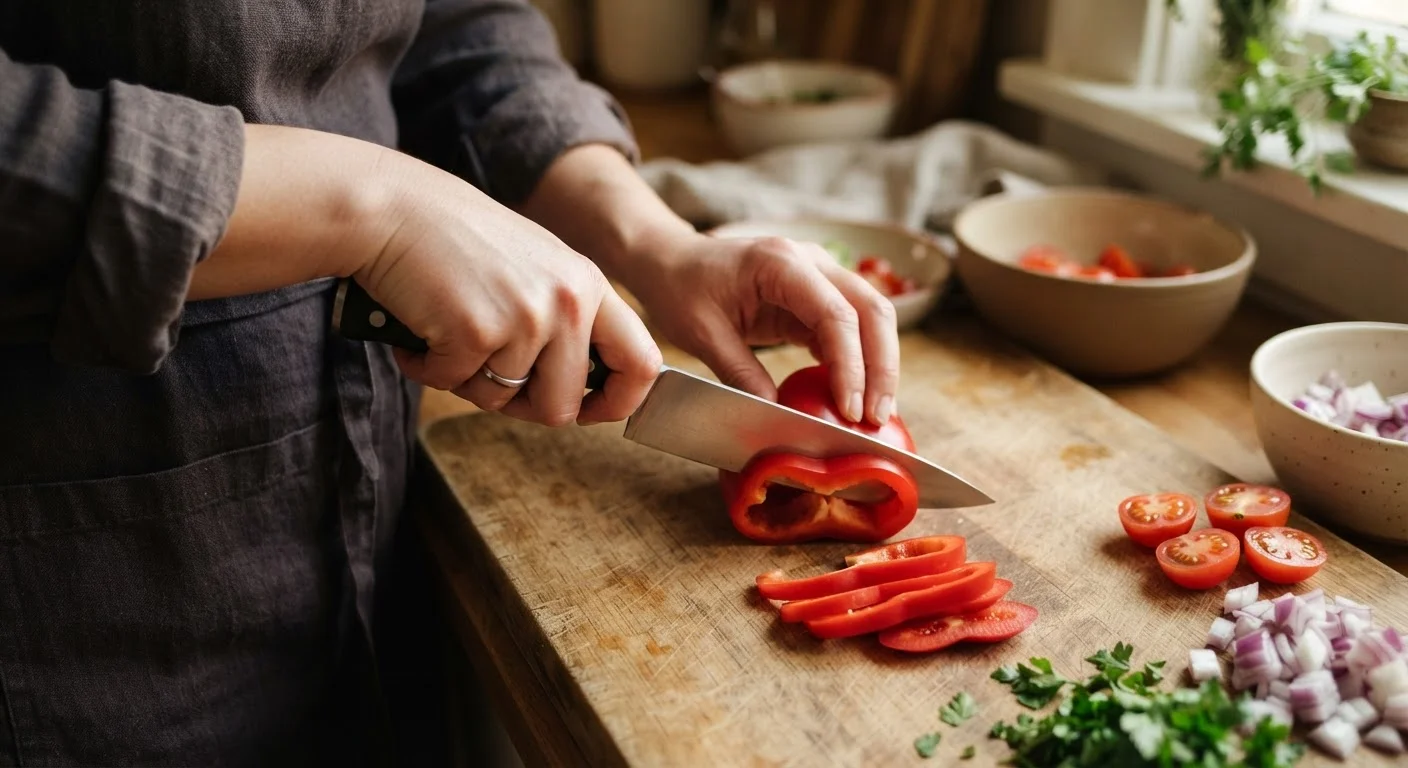
Photo: HorizonMetric.com | One Destination For Everyday Insights editorial
—— In This Article
Key Takeaways
- The pinch grip gives you more control and reduces hand fatigue during prep.
- The claw hand position is the single most effective way to avoid cutting your fingers.
- A sharp knife is safer than a dull one — dull blades require more force and slip more easily.
- Most home cooking relies on just three or four cuts: slice, dice, mince, and chiffonade.
- Consistent knife technique makes your food cook more evenly, not just look more professional.
Why Knife Skills Come First
Before you master a sauce, perfect a roast, or nail a soufflé, there's one skill that underlies almost every other thing you'll do in the kitchen: knowing how to use a knife safely and efficiently. Knife work isn't glamorous, but it's the single biggest lever on how fast, consistent, and enjoyable your cooking experience becomes.
Unevenly cut vegetables cook unevenly — small pieces burn while large ones stay raw. Slow, uncertain prep makes cooking feel like a chore. And a blade handled without proper technique is one of the most common sources of kitchen injuries. None of that has to be your experience. Reading a recipe like a seasoned cook is valuable, but if your prep is slow and stressful, the rest of the process suffers from the start.
Pinch grip
A knife-holding technique where the thumb and index finger pinch the blade itself just above the handle, giving the cook greater control and stability.
Claw hand
A guide-hand position where the fingertips are curled under and the knuckles face the blade, protecting fingers while directing cuts.
Honing
Realigning the microscopic edge of a knife blade using a honing steel. It maintains sharpness between true sharpenings but doesn't remove metal.
Dice
A knife cut that produces uniform cubes of a defined size, helping ingredients cook evenly.
Chiffonade
A cutting technique for leafy herbs and greens where stacked leaves are rolled and sliced crosswise into thin ribbons.
Rock chop
A cutting motion where the knife tip stays on the board and the heel rocks up and down in an arc, used for rough chopping herbs and aromatics.
The Pinch Grip: Your Most Important Habit
Most new cooks grip a knife by wrapping all four fingers around the handle. It feels natural, like holding a hammer. But this grip gives you less control and tires your hand faster. The correct grip is called the pinch grip: place your thumb on one side of the blade and your index finger on the other, right where the blade meets the handle, then wrap your remaining three fingers around the handle.
This positions the blade as a direct extension of your forearm, giving you precise steering and significantly more stability. It takes one or two sessions to feel normal, but once it clicks, you won't go back. Practice it even when cutting soft foods like tomatoes or mushrooms, so it becomes automatic before you're working with harder produce.
Practice on forgiving ingredients first
When you're learning the pinch grip and claw position, start with mushrooms, zucchini, or bananas — soft foods that don't require much force and allow you to focus on hand position rather than cutting resistance. Build muscle memory on easy ingredients before moving to dense vegetables like butternut squash or carrots.
The Claw and the Guide Hand
Your non-knife hand — called the guide hand — does more work than most beginners realize. Its job is to hold the food steady and tell the knife exactly where to cut. To do this safely, curl your fingertips under so your knuckles face the blade. This position is often called the claw.
The side of the blade rests against your knuckles as you cut, using them as a guide rail. Your fingertips stay safely tucked away. Move the guide hand back in small increments after each cut to control the thickness of your slices. This is the single most effective safety habit you can build, and it also makes your cuts faster and more uniform.
For round foods like onions, potatoes, or citrus, always create a flat surface first by cutting the item in half — then place the flat side down before continuing. This eliminates rolling and gives you a stable base.
Core Cutting Motions to Practice
There are two primary cutting motions home cooks use, and knowing when to reach for each one matters.
- Rock chop: Keep the tip of the knife on the board and rock the heel up and down in a fluid arc. This is ideal for herbs, garlic, and onions — anything you're chopping without needing perfectly uniform shapes.
- Push cut (or draw cut): Use a forward-pushing or backward-drawing motion to slice through food cleanly. This works well for vegetables, proteins, and anything where you want a clean, even slice.
Avoid the common beginner mistake of pressing straight down with force. Let the sharpness of the blade do the cutting work — you provide guidance, not pressure. If you're pressing hard, your knife likely needs honing or sharpening. See our practical knife skills guide for a deeper look at motion and efficiency.
Essential Cuts Every Cook Should Know
You don't need to memorize a culinary school's full cutting vocabulary. For everyday home cooking, four cuts cover the overwhelming majority of what recipes ask for:
- Slice: A single, clean cut across the food. Used for tomatoes, cucumbers, bread, and proteins. Thickness varies by recipe.
- Dice: Uniform cubes in small (¼ inch), medium (½ inch), or large (¾ inch) sizes. Creates even pieces that cook at the same rate. Start by cutting planks, then strips, then cubes.
- Mince: Very fine, irregular chopping used for garlic, ginger, herbs, and aromatics. After rough chopping, rock the blade back and forth over the pile, using your guide hand flat on top of the spine to control the knife.
- Chiffonade: Stack flat leaves, roll tightly, and slice crosswise into thin ribbons. Perfect for basil, mint, and leafy greens used as garnish or finishing.
Pair consistent prep with a well-organized workspace — our pre-cooking prep checklist walks you through the full setup.
Keeping Your Knife Sharp and Safe
A sharp knife is counterintuitively the safer choice. Dull blades require more downward force, increasing the chance of slipping and losing control. Keep two maintenance tools on hand: a honing steel and a whetstone or sharpening service.
Hone before each use by running the blade down the steel at roughly a 15–20 degree angle, alternating sides, six to eight strokes per side. This realigns the microscopic edge that bends with use. Sharpen two to four times per year depending on how frequently you cook — sharpening removes a small amount of metal to create a fresh edge.
Store knives on a magnetic strip, in a knife block, or with blade guards. Storing loose in a drawer damages the edge and creates a safety hazard. Always hand-wash and dry knives immediately; dishwashers degrade the edge and handle over time.
Never catch a falling knife
If a knife slides off your cutting board, resist the instinct to grab it. Step back and let it fall. Attempting to catch a falling blade is one of the most common causes of serious kitchen cuts. Keep your cutting board stable by placing a damp towel underneath it to prevent sliding in the first place.
Building these habits now sets you up to explore everything else with more confidence. And if you want to avoid the misconceptions many beginners pick up along the way, take a look at our guide on kitchen myths that trip up new cooks.
Frequently Asked Questions

Food Editorial Team
Food Editorial Team is the collective byline for our editorial team and contributor network. Articles published under this byline or an editorial pen name are researched, written, and reviewed according to our editorial standards for clarity, consistency, and independence before publication.
View author profile